The second game from Disco Elysium studio ZA/UM, this text-heavy, dice-driven RPG is an exquisitely constructed take on consumerism, empire, nostalgia and beyond.
One of the first things I learn about myself in Zero Parades is that I’m a fuck-up – an omnishambling bad omen with cropped hair and unfair cheekbones. Before I was put on ice, I was supposedly one hell of a spy. But that was then, and this is now. The veteran spy fallen from grace is not a new story, but in careful hands, it is almost always a great one. There are so many tiny little things that go right and wrong for an agent in the field: an indifferent tsunami of luck and skill and wildcard entropy that keeps going until the last plastic domino lands on the worst outcome. This is how I end my story as Cascade, an operant who looked her mistakes square in the eye, and believed that maybe, just maybe, the dice and the stars would align for her. They didn’t.
As Cascade, I spend a lot of time trotting around the alleys of Portofiro, fishing perfectly good cigarettes out of garbage, picking up my knees with a high-stepped, buoyant gait as I attempt to redeem myself. I have the manic energy of a highly-trained agent who has finally been let out of “the freezer” after five years, where I ostensibly dwelled on my litany of mistakes like a grounded teenager. The Opera has sent me here to meet my new partner, and I find him trouserless and comatose and utterly incapable of telling me about the actual mission. My only point of contact is alt-universe Olivia Colman playing a slightly-off shop lady, and she wants me to fix the fax machine. It’s great to be back in-theatre.
Zero Parades: For Dead Spies is the second game from a new incarnation of the ZA/UM creative team after the extremely normal and uncontroversial Disco Elysium, a name that turns many self-professed leftists into rabid, single-celled chihuahuas. Like its predecessor, it’s a dice-driven RPG with a conditioning system that hit me like a 15th-century peasant seeing a printed leaflet for the first time. There is a lot to take in. But at the beginning, faced with a blank slate I do a custom build without thinking too hard: I put most of my skills into the Faculty of Relation category, hoping that stats like Personalism and Nerve will lubricate my way forward. When I hit conversational dice checks for specific stats, say, Grey Matter (my brain power) or Entanglement (my sixth sense), I can exert myself by adding another dice to the pool and hope I roll two good numbers. When my rolls go bad, which they frequently do, I turn to canned coffee, beer, and smokes to modulate my internal holy trinity of Fatigue, Anxiety, and Delirium, which have both soft and hard ceilings; once I hit the absolute breaking point for any of these stats, I must lower a related skill as punishment for my hubris. White skill checks can be retried after a certain time, or if you level up the requisite skill. Red checks are danger zones – you get one shot to roll high, then the opportunity is gone, like tears in rain.
I am in Quisach – an area once home to “provincial, but honest” Portofiran culture, a former penal colony of fascist empire La Luz, now awash with mass-produced imports and knockoffs of said imports. Portofiro is ripe for plucking by the most venal economic bullies in the world, namely their Luzian ex-colonisers, who run a secret police called the Weeping Eye. And in this sea of plastic-strewn capital, I dive headfirst into a rich buffet of navelgazing and ass-whooping and ideological purity pissing contests; there are conspiracy theorists and questionable weed and a community phone-sex call that never ends; cursed cosmonaut lore and wild boars and hypebeast influencing; there are moments where I pierce some esoteric veil between reality and the unknown. This fractured world is my oyster, to grip and smash open on my belly like a problematic communist otter. But I am here to figure out my mission, and unravel the fate of my former team – the Whole Sick Crew – that I left for dead in this very same city years ago.
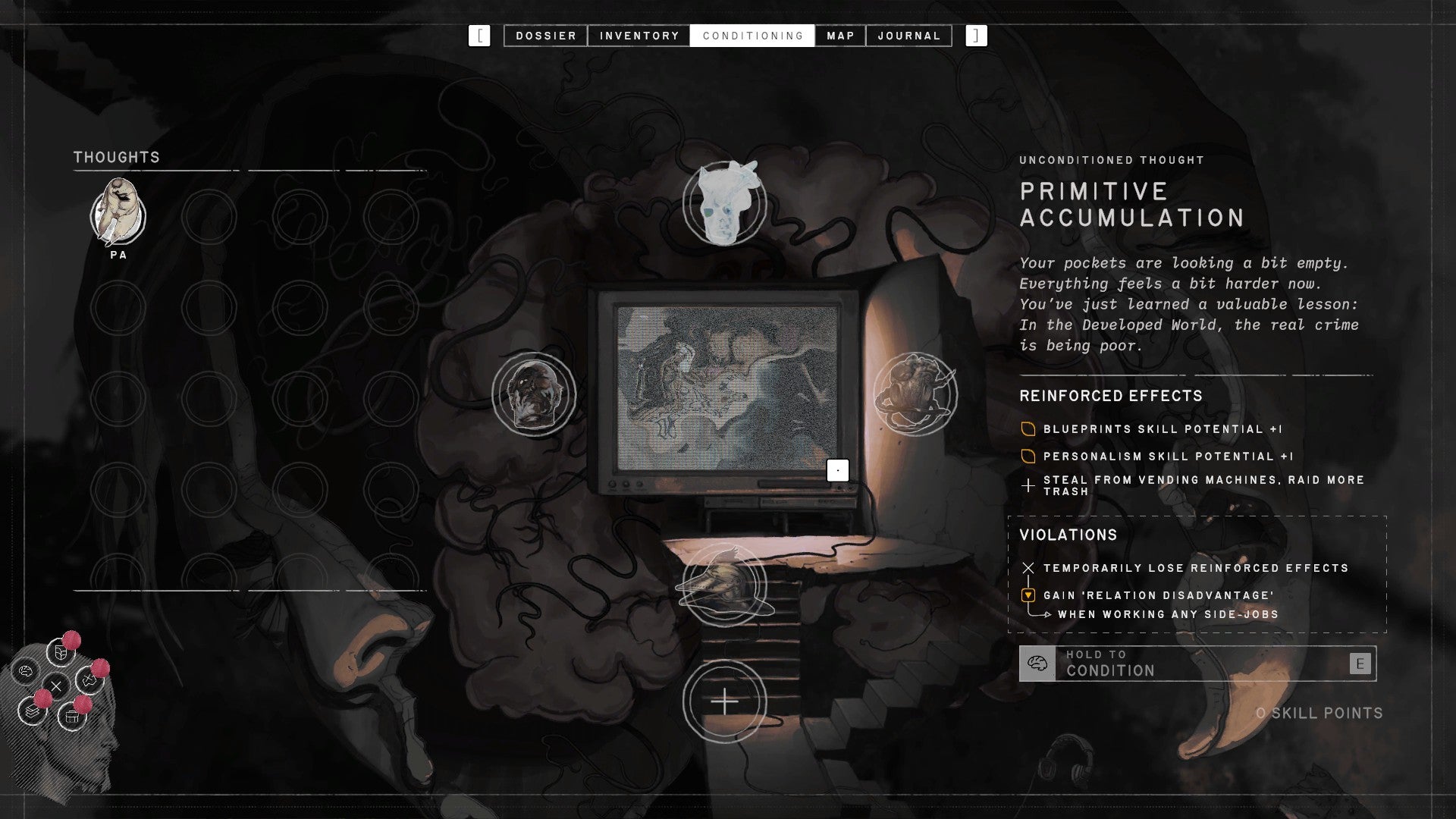
Exploration unlocks thoughts, tuned to specific interactions and reactive moments. I can fixate on up to nine thoughts as part of my conditioning; there are unique advantages to each one, and appropriately-themed penalties for violating their principles. For instance, I succumb to “Latest Synthetic Desires” when confronted with a sexy coffee advert (whomst among us), which raises my potential ceiling for the Instincts stat and reduces fatigue when I drink canned coffee. But if I buy bootlegged goods, the thought gets suppressed and locked for 12 hours. Given the nature of Portofiro’s economy and my Superbloc-induced poverty, it is hard to avoid bootlegged things as a rule, but herein lies the strongest thematic pillar of the game.
There is a razor-sharp throughline of plastic and bootlegging in Zero Parades, written by people who understand, on a cellular level, how a bootleg Goku alarm clock unearthed at an estate sale can be quintessentially Mexican and Arab at the same time, and what that means not just for ‘culture at large’, but for how desire shapes a people and a place and a soul. Portofiro is brimming with postcolonial conflict, as media and fashion continue to bleed in from the Illuminated Empire. It’s not a clean analogy to simply say that La Luz is America, but the dynamic here is recognisable to anyone who has spent meaningful, self-aware time outside the borders of empire.
There is, and has always been an empire here – technofascists to its enemies, vanguard of civilisation to its friends – that purposefully sows its iconography across the world. A hallyu wave of Luzian aesthetics that is, to multiple generations, as familiar as one’s own face. Seeded in these images, of immaculate celebrities and technicolour cartoon wolves, is desire – desire to live a better life, to have nicer things, to be someone else, to have a life somewhere else. Tomio, a gruff janitor working in the Housing Campaign, doesn’t understand this at all; he complains to me about how his son’s obsession with Luzian fashion and posturing has created an impossible gulf between them.
To paraphrase from the game: you can’t conquer want, especially if that want is being strategically pumped out from the beating heart of the Developed World. And when there is want, there is bootlegging.
I previously wrote about the Bootleg Bazaar and material nostalgia in the Zero Parades demo, and the full game expands on these themes with exquisite rigour. I grew up buying $1 VCDs in yellowing plastic bins across Southeast Asia and spent my summer job money on a fake Louis Vuitton x Julie Verhoeven mushroom bag that I carried to ruin after I saw Verhoeven’s work splashed across the pages of Dazed & Confused, a British hipster institution that cost eighteen 2002-era-dollars out here in the former British colonies. That bag was, in the parlance of Ultra Violeta fans (yes, Zero Parades: For Dead Spies has L-Pop), my moonglow, in all its replicated glory. And it was everywhere; I’d bought mine from a “good fake” vendor in the bowels of a Bangkok street market, run by a no-nonsense Thai auntie who walked so that Portofiro’s second-hand fashion queen, Carmuna, could run. To say that the dynamic of postcolonial culture in Zero Parades got personal for me is a severe understatement.
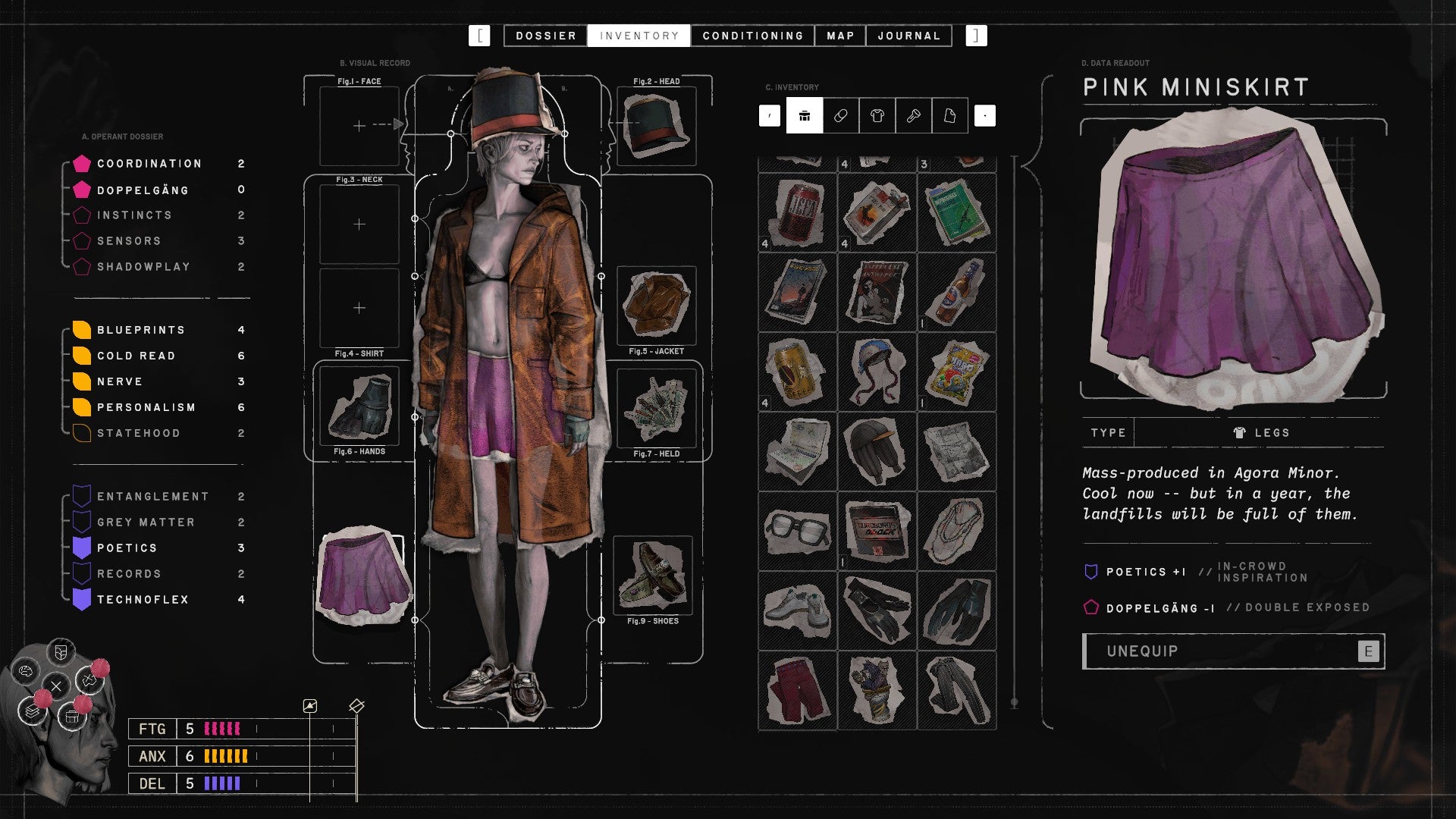
As the out-of-touch middle-aged burnout that is Cascade, there is no way for me, in my present state, to reach across the aforementioned generational chasm without clothing myself in the visual language of La Luz, to show the world that I, too, can understand what it means to be in a so-called brave new world. I have to speak to a pair of extremely mean teenagers for information, and they won’t even look at me if I’m wearing something “bad,” which is everything in my inventory, including a floppy costume head for a pelota ball mascot named Mr. Baby Tofu.
This is more than a better and smarter distillation of Meryl Streep’s now-famous monologue in The Devil Wears Prada about how a preplanned shade of blue trickles down from the upper echelons of haute couture to a Shein warehouse. Zero Parades lays out the politics of aesthetics in an imperial context – the grainier, wonkier versions of clothes and gadgets and slang that reproduce beyond empire’s borders with every new wave of trends. And every time a new trend moves a little further away from the imperial core, it takes on a little of its surroundings, of its new adopters, and becomes a strange cousin to its original. It is the singular pain of explaining to an American that you grew up horny for their cultural language – MTV, milkshakes, Coca-Cola, high school locker gatherings, albeit through fiction and spectacle – while they consistently fail to find your country on a map.
The beginning of the war will be secret, reads the game’s Jenny Holzer epigraph (I had, in 2002, one of the phrase’s earlier siblings from her Truisms series – a wooden “Abuse of power comes as no surprise” postcard that I very insufferably stuck on my wall in college). There is a lot to unpack not just in the message, or the trajectory of Holzer’s art that followed, but in the early production and proliferation of these works on cheap wheat-pasted posters and everyday things like stone benches and payphones around New York City, and eventually straight-up merchandise and t-shirts and stuff. It’s all cheeky political provocation through text and consumerism, and honestly if there was going to be a single on-the-nose epigraph to induct fresh meat into Cascade’s world, Holzer is a fitting choice.
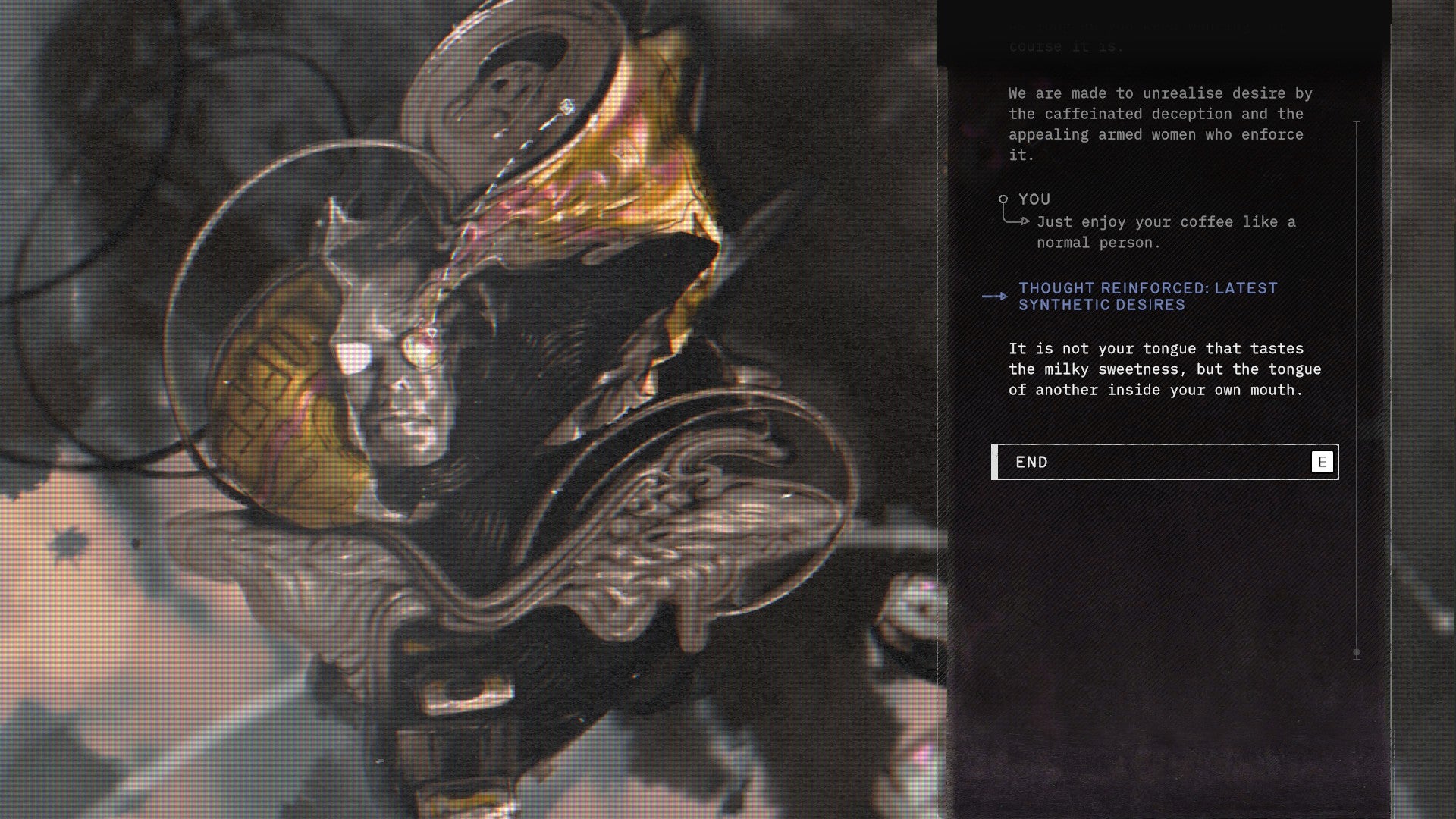
What Zero Parades does brilliantly well, besides the unparalleled moment-to-moment chaos of letting me believe I can actually get away with reckless spy nonsense, is drill down on the hierarchy of these cultural connections so that I am constantly forced to examine my own cultural alignment, my own wants, and what Cascade should want – not just for herself, but for her friends, and her mission. What you desire is not the red-and-black coffee but the solidity of soul that comes with knowing the coffee is your desire, reads “Latest Synthetic Pleasures,” as if understanding the root of my desire somehow validates all the mistakes I make. As if it is easy to simply roll over and say, why does the bigger culture not simply eat the smaller one? Every one of my stupid decisions is undermined by the fickle, competing nature of all of my wants, and the way all of this shapes my experience of shame is beautiful.
What Cascade needs is pretty straightforward. In this so-called free market, I browse disguises: trendy fits beloved by “fan-shifters” who worship Ultra Violeta, cheap plastic sunglasses, the old silk of Portofiro. I pick at discarded objects and bits of plastic – a hybrid tic of self-soothing for Cascade and my own real-life OCD. I run my fingers over the plastic silhouettes of my collectible wolf cups, and even melt one into a hot, acrid puddle in the name of post-historical materialism. I peel the plastic film off an intercom pad, much to the chagrin of its owner, and every day, I boop the soft Renotel dolphin logo on the payphone at the Quisach Roundabout. Squishing the dolphin lowers my Anxiety – the freshly-peeled plastic buff is literally a two-hour Blueprints and Technoflex buff. Through Cascade’s fingertips, I remain firmly attuned to the flesh of mass-produced culture and the zeitgeist, and everyone knows, especially the corporate licensing ghouls, that the zeitgeist wouldn’t be what it is without bootlegging.
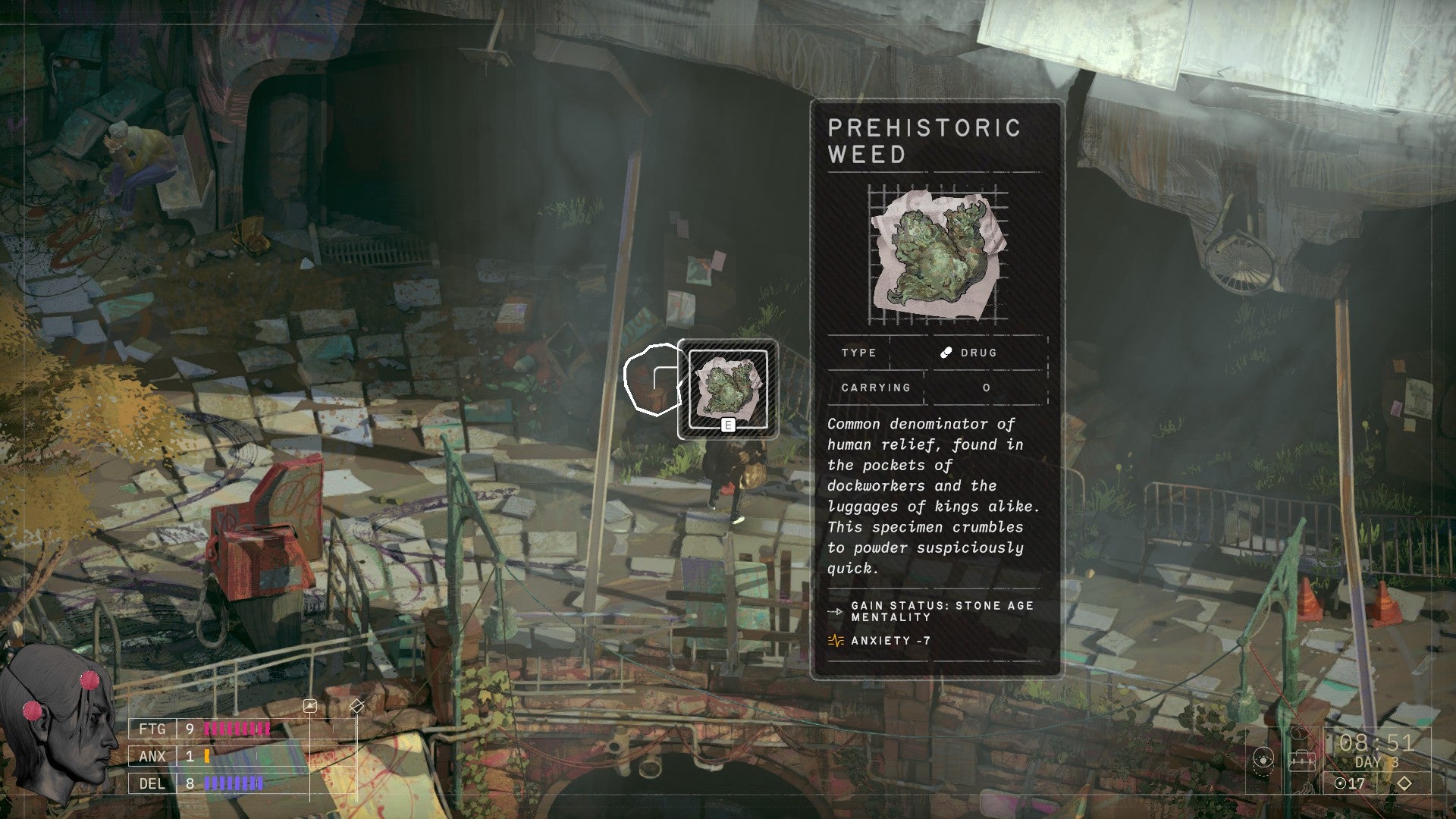
Sprinting around the city in my ludicrous outfits, I feel palpable greed to roll more dice, to soar as close as possible to the sun like a nicotine-greased flying monkey. In the mid-to-late game, my delirium piled up faster than I could manage it, and even though sleep lowers all my internal pressures to normal manageable levels, it is extremely easy for the simplest dice roll to go sideways and send me spiraling. There were times when, despite the dice informing me that I had an “almost trivial” chance of failing a skill check, I immediately rolled snake eyes and sent my Anxiety through the roof. Gambling with Cascade’s psyche is the hot new gacha – so addictive that even when she’s a shambling husk of a person, the dice still offer the sliver of a promise of a comeback. This right here is the linchpin of great underdog drama. There is nothing left to do but laugh, and continue on my way to spy redemption.
When I hit a freeze-time moment – a close-counters “oh shit” situation where Cascade has to make major irreversible decisions on her feet, the dice bring on a new level of adrenaline. Surreal, new-weird visuals illuminate the tableau – neo-medieval shapes rendered like modern street art – as Cascade reacts to an adversary (or a former friend!) in the field. A curled tiger adorned with a snake; two crania pressed together with the anatomical style of a Simone Klimmeck tattoo. These moments are a high-stakes deviation from the baseline neuroses of regular skill checks, to keep Cascade in appropriately paranoid shape and slam an occasional shot of hot, hairy espionage juice directly into the player’s veins.
I ended up committing to the early choices I made with Cascade’s thoughts, wanting to feel fully responsible for her actions as a (mostly) lovably flawed, undiagnosable disaster. I didn’t put too much strategy into conditioning at first, but over time I came to think of them as Cascade’s pathological fixations, with only one or two late-game changes (thoughts can be swapped out at any time, at the price of a cooldown period). The conditioning system is an absolute playground for people who want to min-max builds that synergise optimal thoughts and skills, to hulk out on, say, material needs (having lots of money, for instance, means being able to afford to buy a gun, as opposed to scrounging one up or not having one at all) or technological know-how.
But the real beauty of the game is its bristling reactivity, woven into gorgeous prose and a constellation of characters big and small, each a critical texture in the fabric of a living, breathing story. I move through Portofiro in bursts of adaptation, changing outfits, equipment, tools (but not my thoughts! That’s for next time) where needed, sacrificing my favourite and most hideous miniskirt in exchange for a coveted object, beating the shit out of a sweaty investment banker-type who won’t stop hogging the public phone sex line (sir, that is the people’s phone sex line). Zero Parades is truly full of surprises, at times a little overly-gratuitous sentimentality, and likewise full of real heartbreak (it was my fault! It was and always will be my fault!) for myself as a player, as well as Cascade and her crew. There are so many threads to pull at, so much horribly, horribly good writing and full-circle subplots and ghastly in-jokes for freaks who live for niche historical mysteries, but I can’t talk about them here because the Opera will throw me in the freezer.
But I can tell you how much I love what it does with the politics of material value – of reruns and bootlegs and photocopies, of faxes and substitutes and one-time-use formatting, of cultural fluency, of speaking the language of empire with a hand-me-down accent, the terminally fascist nature of nostalgia, and how capitalism props all of this monstrousness up so well. I haven’t even managed to get into the sound design, the voice acting, the music, and art direction – the cumulative work of a creative team at the top of their game. It is a narrative distillation of the familiar into a messy, painful journey that feels, at turns, cinematic and mundane, sharp and silly – a fine-tuned caricature of humanity’s petty, poisoned psyche, a game made with care, for only the finest sickos.
A copy of Zero Parades: For Dead Spies was provided for this review by ZA/UM.

