The Marvel source material cards are the main reason why I am excited about Magic: The Gathering’s collaboration with Marvel Comics. These are reprints of popular Magic cards featuring borderless art from the comics. As a comic book fan, the prospect of collecting iconic moments from the stories I grew up reading is enough to make me overlook all the issues with Universes Beyond.
Well, maybe not all the issues, but at least Marvel Super Heroes is shaping up to be a much better set than Marvel’s Spider-Man. It also introduces a new slate of source material cards from a wide range of comics and characters, from iconic 1960s creators like Stan Lee and Jack Kirby to modern masterpieces. These cards can be a great chance for new fans to discover some of the stories that made Marvel Comics a cultural icon before the movies came around.
Here are my 10 favorite Marvel source material cards from the Marvel Super Heroes set, and the comic books that inspired them.
10
Anthem of Champions — Contest of Champions
Nowadays, Marvel Comics launches a new big event every year that’s all about stacking as many characters together as possible and seeing what happens. Well, it all started here. Marvel Super Hero Contest of Champions is Marvel Comics’ first-ever limited series. Published from June to August 1982, it was written by Mark Gruenwald and penciled by John Romita Jr. It introduced the concept of crossovers, events involving characters from different comic books, getting together to face a big crisis that usually has an impact on the entire Marvel continuity.
Mark Gruenwald was an ante-litteram visionary. (Just check out his Squadron Supreme run: it was one of the first politically charged big superhero comics, before that became a cool thing to do.) Contest of Champions planted the seed of what would become a standard practice for the House of Ideas, and while that series is less ambitious than Crisis on Infinite Earths, it predates DC Comics’ famous crossover event by three years.
9
Beast Within (Grimm Fate) — This Man… This Monster!

Ben Grimm, aka the ever-loving, blue-eyed Thing, is one of Marvel Comics’ most beloved characters. He perfectly encapsulates the House of Ideas’ early formula for success: superheroes with superproblems. The Thing paid the steepest price for his powers, turning into a rock-skinned monstrosity. This fueled decades of excellent stories that focus on Ben’s struggle with his body, but perhaps none is remembered as fondly as 1966’s “This Man…This Monster!” written by Stan Lee and illustrated by the King himself, Jack Kirby.
In the story, a scientist jealous of Reed Richards’ accomplishments kidnaps the Thing and steals his powers, resulting in the original turning back into his human form. The scientist infiltrates the Baxter Building and tries to assassinate Reed, only to change his mind at the last minute and sacrifice his life to save the Fantastic Four leader. Meanwhile, after awakening in his original form, Ben runs to his girlfriend Alicia to give her the good news. As the scientist dies, however, Ben’s powers return, and he reverts to his monstrous appearance just as Alicia opens the door. That scene answers the question of whether you can break a heart of stone with a resounding “yes.”
It’s also notable that a nameless scientist was able to cure Ben 60 years ago, and in all that time “the world’s smartest man” Reed Richards has failed to do so. What a sham!
8
Counterspell — Iron Man Extremis

This is more a personal favorite than one of the all-time greats, perhaps, but it’s still a milestone in Iron Man continuity. Written by Warren Ellis with art by Adi Granov, “Extremis” is a six-issue story arc that ran in Iron Man between 2005 and 2006. It introduces the Extremis virus (also featured in the movie Iron Man 3), which upgrades Tony Stark with real superpowers, allowing him to connect to his armor and other machines through a neural interface.
Extremis is perhaps the last interesting Iron Man story published (except for the magnificent miniseries Infamous Iron Man, where Doctor Doom takes the mantle of Iron Man). It transformed Tony Stark from “former alcoholic rich guy in a suit” into his modern image of a futurist, before that term was spoiled by creepy technocrats.
7
Extinction Event — Infinity Gauntlet

Thanos and his infamous Snap in Avengers: Infinity War became the most iconic moment of the golden age of MCU movies. 27 years before Josh Brolin “blipped” half of the universe away, Jim Starlin wrote one of the most important sagas in Marvel history, bringing back the character he created two decades prior. The six-issue limited series The Infinity Gauntlet shows the outcome of Thanos’s quest to collect the Infinity Gems (shown in The Thanos Quest). The Mad Titan has obtained absolute power over creation, but will it be enough to please his cold mistress, Lady Death?
Before Hollywood success went to his head (and ruined his comic book characterizations), Thanos was one of the most fascinating Marvel characters, a villain fueled by philosophical musings and unrequited love more than lust for power or conquest. This is Starlin’s Thanos at his best, and the incredible art by George Pérez and Ron Lim brings to life an apocalyptic tale unfolding at the edge of the universe, where gods are brought to heel and a Mad Titan finally gets his wish.
6
Final Act — The Galactus Trilogy

If you don’t know where this artwork is from, what are you even doing here? (Seriously, run to buy any edition of Stan Lee and Jack Kirby’s “The Galactus Trilogy” you can put your hands on. This is history we’re talking about.)
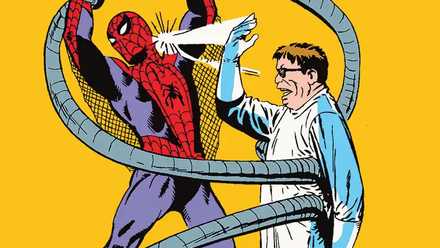
The best Marvel’s Spider-Man bonus sheet cards (and the comics that inspired them)
Some truly iconic Spider-Man moments are showcased in MTG’s new set
5
Final Showdown — Avengers: Under Siege

Before Marvel events became excessively bloated, every series could get a big, epic storyline that felt like an event but did not require you to buy a hundred different comics to know what was going on. In 1986, writer Roger Stern and artist John Buscema delivered one of the most memorable stories to ever appear in The Avengers. Helmut Zemo, the son of classic Captain America villain Heinrich Zemo, assembles the Masters of Evil, a supervillain group that served as a punching bag for the Avengers over the years. They storm Avengers Mansion, beat Hercules into a coma and even injure poor Jarvis.
At the time, the Avengers had several powerhouses in their team, including Thor, Hercules, and Captain Marvel (Monica Rambeau), so it was truly shocking to see them not just defeated, but humiliated and wounded. It was a reminder that villains could be terrifying if they ever decided to cross a line, and a sign that even mainline superhero comics were fully embracing the mature attitude of ‘80s comic books.
4
Heroic Intervention — Marvel Super Heroes Secret Wars

If Contest of Champions opened the door for crossovers, Secret Wars smashed those doors down. Conceived as a big marketing gambit that would tie in with a Mattel toy line and an RPG from TSR, this massive 1984-1985 event spanned over 12 issues of the main limited series and more than two dozen crossover issues of ongoing series. Written by Marvel Comics editor-in-chief Jim Shooter, with art by Mike Zeck, Bob Layton, and John Beatty, the series sees a host of heroes and villains transported to a mysterious planet dubbed Battleworld by an omnipotent entity known as the Beyonder, and forced into an all-out battle for survival.
In one of the most iconic moments in the series, the villain Molecule Man drops an entire mountain range (yup) on the heroes’ heads. The good guys barely survive in a wedge dug by Iron Man and Hulk, but the Green Goliath is carrying the entire weight of the mountains on his shoulders. To buy enough time to build a contraption to escape, Reed Richards insults Hulk since getting angrier makes him even stronger. Who else could have come up with this plan if not Marvel’s number one a-hole? It’s a pretty amazing moment and still one of Hulk’s greatest feats of strength.
3
Horn of Greed — Doctor Doom Toots as He Pleases

You’ve seen the meme — now learn the story behind it! This infamous panel from 1981’s Spidey Super Stories #53 shows my two favorite characters in the Marvel Universe, Namor and Doctor Doom, doing horn-related shenanigans. The story itself isn’t that significant, but the pervasiveness of the meme made it worthy of a Source Material card. As a Victor Von Doom stan, I could not agree more.
2
Show and Tell — Behold…The Vision!

Nostalgia has a dangerous lure, but I can’t help being fascinated by the artistic vision that erupted from the covers of comic books in the ‘60s and ‘70s. The medium was still new, and titans like Jack Kirby and John Buscema were able to experiment and flex their creativity with a degree of freedom that is unthinkable today.
On this cover for Avengers #57, Buscema introduces the character of the Vision, created by Roy Thomas as the tragic spawn of the evil AI Ultron. The synthezoid emerges from the mist, towering over the frightened Avengers with a commanding gesture. Before media marketing campaigns and the internet, comic books were mostly sold by their covers, and Buscema perfectly understood the assignment, leaving us a legacy of memorable art that remains awe-inspiring today.
1
Sundering Growth — Sensational She-Hulk

Speaking of artists who loved to push the envelope, John Byrne’s run on Sensational She-Hulk in the late ‘80s and early ‘90s marked one of the few truly avant-garde moments in Marvel Comics history. Byrne took a minor character in the House of Ideas’ roster and turned it into a fourth-wall-breaking sensation. Towering over the series’ covers with a dominating, ultra-sexualized physicality, Jen Walters was threatening readers to rip up their X-Men collection if they didn’t buy her book, and openly mocking comics’ narrative tropes.
There’s no point in denying that the sexist tinges of Jen’s representation in the series were targeted at an audience of hormone-fueled, adolescent boys, but Byrne was still able to turn a relatively obscure character into one of the few culturally relevant women in Marvel Comics, at least for a while. It’s very cool that Magic’s homage to that historic run shows She-Hulk literally breaking the fourth wall.

