David Lowery didn’t set out to make the 2026 version of Suspiria, but that’s kind of what happened.
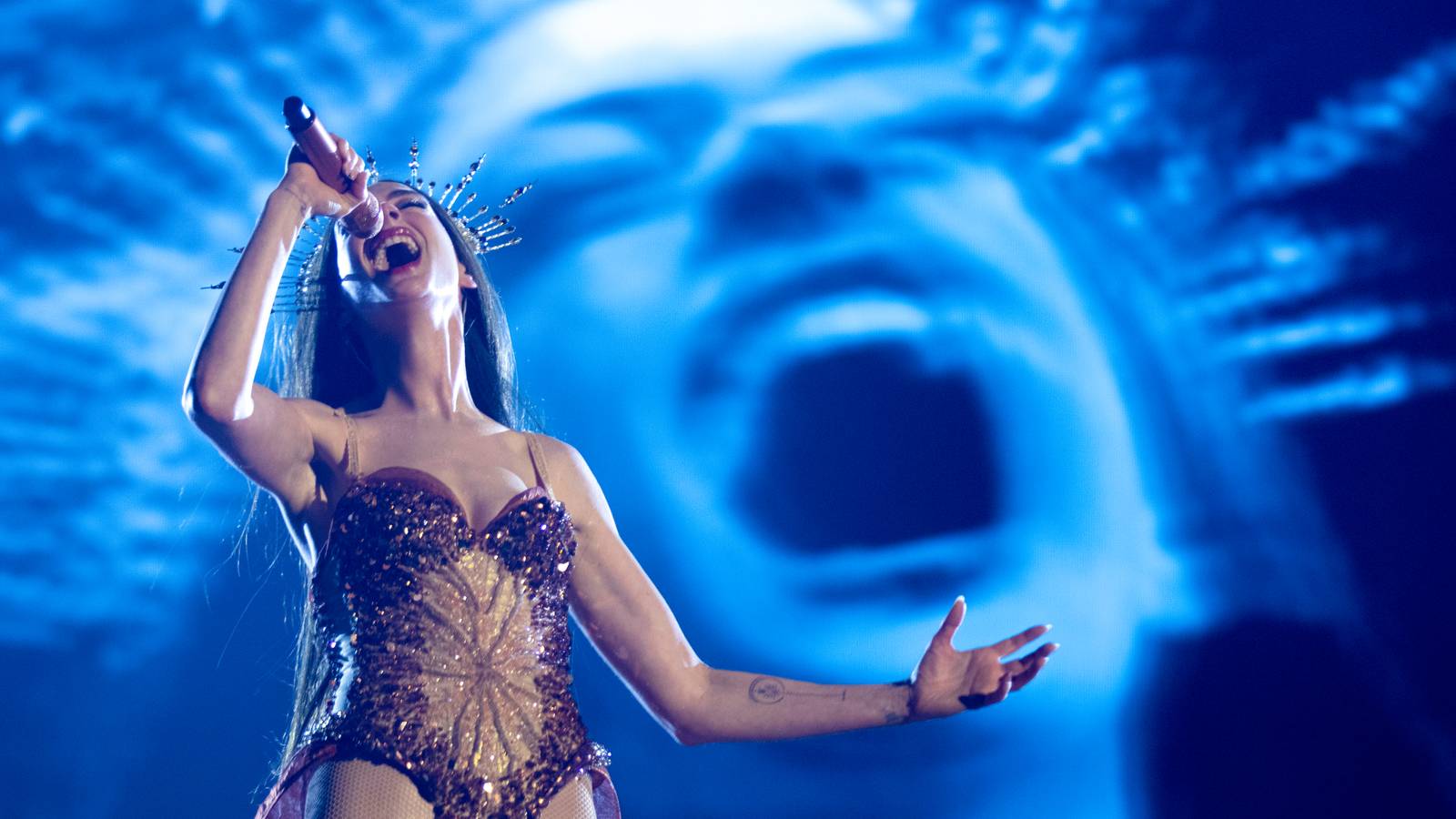
The 1977 giallo horror classic about a coven of witches posing as dancers has a surprising amount in common with Lowery’s latest thriller, Mother Mary, which explores the supernatural connection between pop star Mother Mary (Anne Hathaway) and her former costume designer Sam (Michaela Coel). Both feature unholy forces, intensely physical dance routines, and a strikingly colorful and haunting visual climax. But that similarity was never the goal.
“I love both versions of Suspiria. I wasn’t thinking overtly about them, but I definitely am now,” Lowery tells Polygon. “There is something incredibly supernatural about dance. What dancers are able to do with their bodies transcends what seems to be the physical laws of reality that apply to all of us. It really feels like witchcraft. The thin line between performance, between movement, between choreography, between sorcery and conjuring up some unspeakable, ancient spirit runs through all of those movies.”
In other words, if you’re a fan of Suspiria, you’ll probably love Mother Mary, which borrows from Italy’s stylish giallo movement while updating it for both Letterboxd sensibilities and the modern concert-movie era. And even if you’re not a fan of moody, hypnotic horror,, I recommend giving this movie a try — it’s unlike anything I’ve seen in years.
In an interview with Polygon, Lowery breaks down several key scenes, moments, and visuals from Mother Mary. There are light spoilers below, and you’ll probably enjoy reading this more after seeing the movie, but if you’re on the fence, it may also offer a taste of what makes the experience so unique.
1
Anne Hathaway’s six pack
Early in the movie, after Mary shows up at Sam’s remote costume studio demanding a new outfit for her comeback tour, Sam agrees and begins to take measurements. This scene includes a moment where Anne Hathaway lifts up her shirt just high enough to reveal an absolutely shredded six pack. (There were audible yelps of shock during my screening at this scene that rivaled any of the supernatural stuff that followed.) Lowery says he never asked Hathaway to get ripped for the role, which includes some very physical dancing.
When Anne read the script, she understood what it would ask of her physically in a way I hadn’t even wrapped my head around yet. She instantly knew that she was going to have to go to pop-star bootcamp. That process began three months before we began filming. So when she arrived on set, she was already in great shape. She’s always been in great shape, but she was in a different type of shape than she ever had been before because she’d been transforming her body for this movie.”
2
Designing the “ghost”

As Mother Mary continues, we learn that a “ghost” has tormented both Sam and Mary. The creature, or “entity,” as Lowery calls it, first appears to Sam one night after escaping from her body. It takes the form of a flowing red sheet of fabric, semi-transparent and always fluttering in the wind (even when there is none). Later, the ghost appears to Mary, adorned with a red circle that resembles the halo-like headpieces she wears during her concerts.
“You’re looking at red fabric,” Lowery says. “It’s a lot of different types of red fabric, but it’s all real.”
For Lowery, coming up with the visual look of the ghost was one of the most difficult parts of making Mother Mary, and its design evolved dramatically from how he first envisioned it while writing the script to what we see onscreen.
We spent a long time trying to figure out what this apparition was going to look like, what form it would take. In the script, she was always described as the ‘Red Woman.’ When I was writing, I was assuming there’d be a humanoid form, some sort of spectral apparition, like what you see at the beginning of Ghostbusters. But the more I got into the pre-production process and started trying to figure out how we would shoot these sequences, I realized that wasn’t enough. If we just relied on the traditional visual signifiers of a ghost or a spectral presence, it wouldn’t capture what this entity actually represented.
So I dove headfirst into drawing up a lot of sketches. I got some red clay and started sculpting maquettes to try to figure out what form I wanted to see. Not even to try to create a sculpture; I was just exploring, trying to look at different shapes, different objects, different transmutations of substances. I looked at a lot of reference material online and considered a lot of different effects. Ultimately, I found this artist named Daniel Wurtzel, based in Brooklyn, who does sculpture involving fabric and air. He uses fans and these very incredible custom air tables to keep fabric in a fluid state and to exhibit it in a fluid state.
When I saw those, it was like looking at a ghost. It was like looking at a ghost I’d never seen before. And I realized that fits with what we’re looking for, because this is a ghost — I’m going to call it a ghost because that’s how the character referred to it — but it is a ghost that is coming from Sam and journeying to Mother Mary. But because it came from Sam, it felt so appropriate that it takes a form so familiar to her, and her means of expression is through fabric, through fashion. So to have a ghost that is rooted in those same materials that she would have at hand, it felt exactly right. But it was never fabric in a solid state. It was always in a state of flux.
I love the idea of an entity trying to figure out what form to take, something that is not human trying to figure out how to manifest for human beings to be perceived by humans. And that state of flux was represented in this artwork from Daniel Wurtzel.
So we brought him into the process and he helped us create this ghost. We also worked with my choreographer, Dani Vitale, to figure out the movement of the spirit. And when you see that red disc in the film that begins to emerge from the fabric, that’s actually a headpiece worn by one of our dancers, Taylor Sieve, who was at the concert doing all of the movements with Annie so she could interact with her. We kept the head and replaced the body with the fabric. So everything is real. We shot them all separately and composited them together. I wanted something that felt tangible and yet entirely ephemeral at the same time.
It’s representative of the whole process of the movie, which was like knowing that we’re reaching for something, not knowing how to define it and just seizing. We never stopped digging. And in the case of trying to create this entity, I just kept pushing until I finally found something that felt like it represented… not even what I saw in my mind, because I didn’t see anything, but what I felt was possible.

As for whether this entity is a ghost in the traditional sense, Lowery believes that Mother Mary is “fairly clear” in its explanation of what’s happening. We’re not seeing the spirit of some other dead person who’s haunting Sam and Mary, rather it’s the manifestation of the strained relationship between these two characters.
I think it can be fairly clear. There’s a transference of energy between these characters. There’s a transference of energy between anyone who’s engaging. You and I have an exchange of energy at the moment that is thankfully not going to manifest the Red Spirit. But the exchange of energy between two people can be incredibly intense. It can be incredibly profound and indeed life-changing. I wanted to give that energy a form. We call that form a ghost because that might be the best word for it, but it is something that is shared between two people. You feel that when you’re in a relationship or a creative collaboration. That intangible connection is sometimes so strong it feels like an actual physical tie between you and whoever you’re collaborating with. I just took it one step further and made it tangible.
3
3. Mother Mary’s climactic fall

After being birthed by Sam, the entity follows Mother Mary while she’son tour. The haunting culminates at a concert where Mary gets spooked by the ghost and falls off a large floating platform. She’s caught by safety ropes, but the shock of the event causes her to cut her tour short and go into hiding for several months before returning with a new song about the experience titled “Spooky Action.”
Like the ghost itself, Lowery says that filming this scene required a creative blend of practical effects and camera trickery.
Every single bit of that was real. Annie was really up on that platform rising up above the crowd, and we had a camera mounted up there with her. It was incredible to behold. We were shooting the wide shots first, where we got to be a little bit more objective and just thrilled by the spectacle of it. But then when we put the camera up on the platform with her to get the closeups, to see the emotional journey she’s going on as she rises up away from the adoring fans into this liminal space that you can’t quite define up in the darkness, up in the rafters, it was a reminder of what the scene was actually about. Anne knew this was a performance that was very public and she had to give it her all, but that there was something very intensely private happening at the same time.
The fall itself was a stunt that an incredible stunt performer did. And then all the stuff that’s intercut around that — in a movie that is full of words, I wanted there to be a sequence that almost felt like a visual symphony, that cast the dialogue aside. So it was just the images telling the story.
Bonus: Quantum physics in Mother Mary

Mother Mary also explores a surprising topic: the scientific phenomenon known as quantum entanglement, in which two particles become linked in a way where any changes to the state of one occurs to the other, even if they are spread across the universe. In the 1940s, Albert Einstein mockingly described the theory as “spooky action at a distance.” In his movie, Lowery directly references this with the title of Mary’s new song, “Spooky Action,” implying a sort of quantum entanglement between the two protagonists that helps explain their intense, supernatural connection.
For Lowery, this was also a chance to show off his own knowledge of quantum physics.
I’ve been researching quantum physics for years. My brain breaks when I get too deep into it. But unlike mathematics, which I’m terrible at, there is a strange poetry to quantum physics that I can just begin to scratch the surface of. I’d been working on another project that really had me digging deep into all the practicalities of quantum physics, like the Large Hadron Collider, which they reference in Mother Mary. I know all about how it works, and the thing that always stuck with me was the poetry of it. The idea that a particle on one side of the universe can be engaged with a particle on the other side of the universe, and what happens to one will happen to the other, in spite of the fact that they are a billion miles apart from one another is an incredible fact of reality, but also an incredible metaphor.
The idea that these particles can feel each other’s feelings is too good a metaphor to pass up. And I’ve been waiting for a chance to not only use it in a movie, but then to talk about it afterward. Because I love how it changes the way you think about the mechanics of the universe in such a profound way. I’m not a particularly spiritual person, but when I think about things like ‘spooky action at a distance,’ I feel there’s a membrane beyond the reality that we know that I can see through just a little bit, and it really blows my mind.
Mother Mary is in limited theaters now with a wider release on April 24.