It wouldn’t be a Fable preview if I wasn’t at least a little bit wary of encouraging you to get your hopes up. But, forgive me, I’m going to. I’ve seen a good half hour of continuous gameplay and, although it comes with plenty of caveats, it really was fantastic. Playground Games’ Fable reboot looks to be silly, crass, British, beautiful, systemic, and maybe a little overambitious. In other words it looks like Fable. Indeed few things are more Fable than promising the Moon, after all – 1,000 unique, romanceable, morality driven NPCs! Each with reactive personalities of their own! – and in turn leaving eager players wondering if you can really pull it off. This first look offers some promise that Playground can. And maybe more importantly, that its developers actually get Fable well enough that they know they need to try.
The demo, held behind closed doors immediately after Xbox’s big summer showcase, was led by Playground’s two associate directors, Craig Littler and Will Kennedy. Littler, playing as he went, opened with a description of Fable as being “a game within a game,” and all at once “a life sim, a social sim, an economic sim.” Peter Molyneux might not have had a thing to do with this game – Littler told me that while “Peter is a legend,” the new Fable team hadn’t spoken to him “at all” for this project when I asked (nor do they mind him making a game called Masters of Albion: “To be honest, I’ve got my own Albion to worry about.”) – but his spirit of big ideas and bold claims at least lives on. And again, there’s a case to make that it wouldn’t be Fable without it.
As for the demo itself, the focus here was on the concept of “building an extraordinary life” which – in less ‘key design pillar’ PowerPoint terms – means a demonstration of the many interlocking, interpersonal systems you can find yourself toying around with entirely outside of the main quest. In fact, when asked about the main story – a focus of Fable’s bombastic showcase trailer – Littler and Kennedy were evasive, promising more on that down the line. As Littler put it to me: “I think it’s really important to clear up that this isn’t Fable 4. This is very much Playground’s vision of what Fable means to us; that meant building a story that incorporates the elements that we feel are important to our vision of Fable. But it’s not connected directly in any way to the various Fables [released before].”
Here in this Fable then, we started out on horseback, trotting into the village of Silverbrook, a farming town with an almost unhealthy obsession with vegetables driving its visual theme, itself set in the idyllic fields of Oakshire. The immediate impression is one of lavish, archetypical rural beauty; Oakshire’s rolling green hills and swaying fields of wheat could be plucked straight from a Tory party poster. And if that weren’t enough, one of the first interactions we have in the village is with a pig.
Colin, a pig that can talk, is set to be killed for an upcoming feast. A little boy calls you over to help stop the butchery, while an apparently sociopathic owner wants to go ahead with the slaughter because despite Colin being quite nice, the boy did have to fork out for him. This sets up the first of many illustrative decisions made in the demo: a decision of whether the pig lives or dies, then a few choices for convincing his owner to keep him alive once we made that decision (you could fight him, give up, or pay him off, we chose the latter). And so Colin went free, and we got the first of many artful little pop-ups in cursive handwriting to say we’d gained the reputation for being Virtuous.
Nearby, Jack the Beggar, who like all NPCs has a little info box open up when you chat to him, is labelled as a hardworking commoner, who likes us because we have the Virtuous reputation, which means he thinks we’re principled. And this is Fable’s very, very smart system of morality in microcosm: almost everything you do in the game, from how you handle simple conversations to how romances play out or how much money you splash, gives you various reputations – of which there seem to be a huge amount: virtuous, rich, cruel, etc.
That reputation is localised to the town where you earned it, and it’s more or less always something you can change, even at the extreme end after a classic “what if I just whack a few villagers with my sword for a bit” moment, as long as you either put in the hard graft to re-earn each individual’s fondness, or pay off the local town crier to spread a certain view of you.
What’s more, each NPC in the game has an entirely personal moral code, informed by the type of person they are – hardworking commoner, ambitious commoner, etc. We see this play out nicely, of course, in the demo designed to show off exactly that. We give Jack the Beggar some money and he likes us more, as we pick up the reputation for being Kind. Nearby is a general store, meanwhile, with a woman working there called Megan the Merchant, who’s a little fond of us already because she thinks we’re shrewd and savvy after negotiating with the farmer for the pig’s release. Littler selects the romance submenu of the dialogue options and she suggests she’d be open to a date, if we filled out a few more conditions: wear fancy clothes, own a home, and be known as an entrepreneur. Let nobody say Megan doesn’t know what she wants in a man.
Any home can be bought, for a price, and once you’ve made the purchase, you can decide what you want to do as a new landlord – boot out the occupants, jack up the rent, offer them a bit of money to leave, and so on, each with knock-on effects on your reputation. To become an entrepreneur, we need to own a business. Like houses, any business in the game can be owned, we’re told, and so naturally Littler decides to buy the local pub. To buy a pub we need more money, so we go and get a job nearby as a blacksmith, completing a truncated version of a smithing minigame where you need to accurately strike certain hot points of the metal, and earning more cash the better job we do.
We buy the pub, for about a hundred grand, and can now toggle all sorts of things in another menu dedicated to it: who we hire, how much we charge, how much we pay our employees and so on. Our current bartender, Susan, gives a +10% modifier to income because, as a caring commoner, she’s great with the customers. And since Jack the Beggar is a hardworking commoner we decide he’d be a solid hire, and give him a job – he’s now known as Jack the Bartender, and especially thankful. Meanwhile, we’re an entrepreneur and known as Rich, since we just threw a lot of money around.
But while that all puts us in good stead with Megan, others, such as Rhiannon the Tailor, aren’t so keen. She’s a humble commoner and frankly despises you for being a rich entrepreneur and so thinks you’re out of touch (again, all this is the exact phrasing from the little submenus shown when you chat to each NPCs). She jacks up her prices by a whopping 80% as a result, and is frightfully rude, but we’re rich so it’s fine. We change into the outift – at any wardrobe in the game you can also change your appearance, including skin tone, hair, body type, and voice, though we stick with the current ones here. Back to Megan! And we can now go on a date.
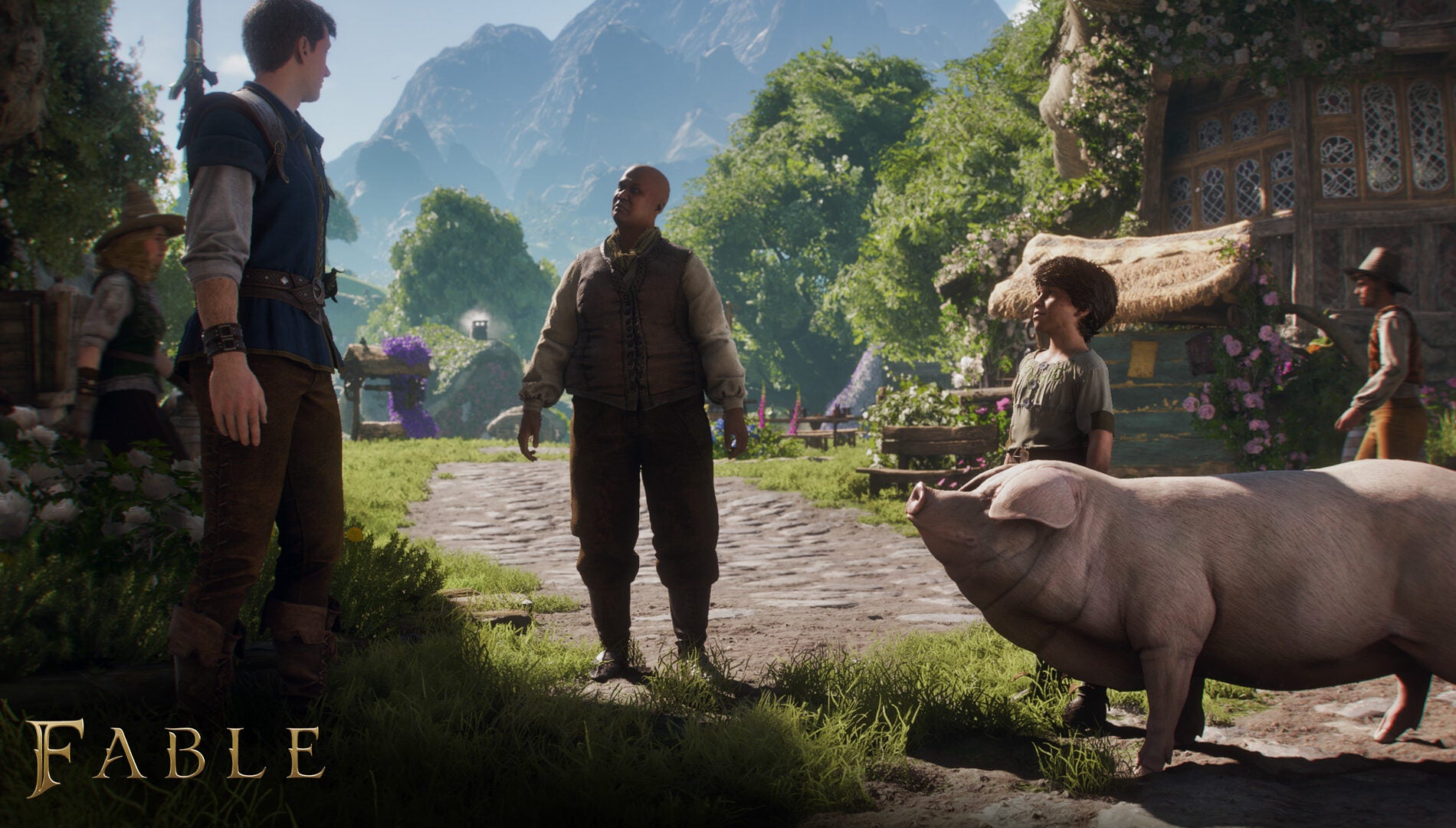
The latest screenshots from June 2026.
The date itself is pretty simple, and maybe an example of where these interlocking systems start to hit their limits – it’s a quick cutscene-like scenario of the two of us talking, and then afterwards when chatting with her again we have options to make things official (in doing that, I spotted a little pop-up noting that our parents are now considering allowing us to get married and that we can do so once they approve down the line). Similarly, a question was asked as to whether your reputation directly impacts the success of your business with customers, and the answer from Kennedy was somewhat evasive, suggesting, essentially: probably not. But he did promise “a whole host of other ways the system will respond to reputation” that weren’t shown here.
One fun sidenote on relationships from Littler: “One of our developers came over to the designers one day and said, ‘Where’s Helen?’ And the design team’s like, ‘Who’s Helen?’ ‘The barmaid in the pub! I’ve been working on the pub, and she’s gone.’ It’s like, oh, Helen was a placeholder. Helen is not staying in the game.”
Meanwhile, our pub has a classic video game concept buried beneath it: in the basement is a kind of magic chest, where all income from all your business can be accessed and collected. It also, I noticed, had a smaller door within the front door, which I thought was curious. Could this be a sign we can have pets in the game? “That door is actually for Colin,” Littler laughed. As for whether we might have pets and more of these little doors: “Every pub doesn’t have a Colin.” Read that as somewhere between no and maybe.
Then, after the successful date, Littler opts to go full villain and break it off with poor Megan, then sack the lovely Susan, then go on a killing spree. Megan thinks you’re a heartbreaker now and that you’re therefore Out of Order, which is a fantastic phrasing and also entirely accurate since we literally just asked her out. Susan thinks you’re heartless and isn’t a fan – but other people, we’re told, might fancy you precisely because you’re heartless. Which is what brings it back to the core point about this very smart, localised system of morality.
Rather than being a kind of linear good-bad scale, or a personal moral score of any kind that’s always applied, morality in the Fable reboot is based on what other people think, and every person in the game thinks in a slightly different way – a lot like real life. “I remember back when we were in the early stages of the project,” Littler said, “thinking about what that could look like. We were looking at different models of it, we were trying to see how it could be represented, and one of the things that we kept coming back to is the way that not everyone agrees on everything. That’s the thing that you see in the world today all the time, and even in our discussions we were finding that as well, and we thought there’s something really, really special about that, and so we really leaned into that, and then we arrived at the reputation system that you see today that captures that subjective, multifaceted view of morality.”
Meanwhile, a very quick look at the combat and: cor. In a flash of fighting with town guards we see some crossbow attacks and flourish-heavy swordplay, plus a range of magical abilities. One lets you lift enemies up by a magical vine, hanging them by their ankles – with, we later see, the option to slam them back into the ground with a thud. Another is a classic, but very nicely visualised fireball. In sword combat you dart about acrobatically, or dash in a blink across a fair distance. It’s always tough to judge combat when it’s not in your hands, but from a distance it looks snappy and expressive, with room for a bit of humour as well.
As the guards keep coming we run away, riding off into another field, and get a quick look at the bounty system. You can pay it off, which’ll remove your criminal label but won’t magically make everyone forget you’re a horrible heartless heartbreaker (that’s what the town crier is for). And you can just head to another region, where it’s cheaper to pay the fine and where your reputation doesn’t follow you, to start all over again. “I’ve made a reputation there in Silverbrook, but if I go to a new settlement, those people have never heard of me,” Littler explains. “So, the next one, I might not be anything like that. I might be a weird killer, a criminal, and promiscuous.”
Back in Silverbrook, as we see from the map screen, we’re known as a killer, shrewd, rich, a criminal, charming, and an entrepreneur all at once. And in barely half an hour, as Littler is understandably keen to point out, we’ve done a great deal: saved a talking pig, bought a house and a business, changed our appearance, got into and out of a relationship, got a job, and became a murderous villain.
It’s a remarkable demo, presumably designed to show you the actual moment-to-moment cycle of deciding you want to do ‘X’ on a whim, and therefore decide to spend a bit of time doing ‘Y’ and ‘Z’ to get there. Which, again, is all very Fable. Speaking of which, there are some caveats and unanswered questions, naturally. Fable largely looked fantastic, but the lip syncing was well off, in need of some proper work before release in early 2027 (likely a factor of having quite so many NPCs to independently voice – the voice acting itself is good fun and appropriately Bri’ish at least). Similarly, beautiful as I found Fable, I suspect there’s still work to do on the game’s performance. Littler said the demo was running at a locked 30 frames-per-second, seemingly on a Series X devkit, and mentioned that “there will be a performance mode at launch as well” when I asked about how it’s been going in getting it to run on the Series S.
Likewise, it’s a little unclear just how far these systems go. It’s hugely impressive how many systems you can find yourself entangled with in half an hour, but that also makes me wonder how much depth is there to each of them. I suspect that depth will surface in the playing, when you start hiring people to boost income and building more complex reputations over time, rather than in a single isolated village from scratch – and in a way, breeziness is also part of Fable’s charm. And the date with poor, spurned Megan was maybe a smidge underwhelming, a missed opportunity for a minigame or at least another gag.
But the lingering impression, for me, is one of genuine excitement at what this take on Fable could be. It’s always been about all the themes we know – the local humour, the off-beat fantasy, the morality systems – but more than that it’s always been about taking a big swing, and doing so with a sense of honest, playful creativity from the developers behind it. And everything else aside, it’s there, I think, that Fable is already looking like a real success.

