It was never a question that Final Fantasy 7 would have a place in Polygon’s celebration of the 100 greatest video game quotes of all time. But there was some pretty spirited debate about which FF7 quotes were worthy of inclusion. Barrett’s simple yet memorable “Planet’s dyin’, Cloud” made the cut, while the localization error “This guy are sick” did not. But the quote that most bears closer inspection is not pithy, hilarious, or badass. It is frantic, disjointed, and terribly sad.
Aerith’s death elevates Final Fantasy 7 from a merely excellent game to an all-timer, and this quote is Cloud’s reaction to that:
Aerith is gone. Aerith will no longer talk, no longer laugh, cry…… or get angry…… What about us…… what are WE supposed to do? What about my pain? My fingers are tingling. My mouth is dry. My eyes are burning!
Sephiroth’s attack is unexpected and disturbingly violent. Cloud’s horrified reaction takes us through the flurry of emotions as they’re happening. It’s not a beautiful set of sentences at all, but a stream of consciousness narration that feels raw and real. His blow-by-blow account of what’s happening to him physically is unusually childlike and vulnerable, especially from someone who’s gone to considerable effort to look like a hard-assed mercenary. In this moment, he’s just a scared young man who loves his friend — and hates himself.
The 1997 version of this scene isn’t accompanied by voice acting, but if it were, you’d have to imagine it would be punctuated by ragged gasps and the viscous slurp of a runny nose. Cloud’s real-time commentary makes this moment feel like an out-of-body experience. It signals to the player that this is not a condition the party can fix with magic spells or a Phoenix Down. This is permanent and final: Aerith will no longer be a member of your party from this point onward. With these words, Cloud is realizing in real time, along with the player, that Aerith is truly gone forever. The twist was unprecedented and shocking for its time, seared itself onto the hearts of millions of millennials, and influenced countless games in the decades since its release.
I had wondered whether Cloud’s speech differs for English-speaking audiences. It wasn’t uncommon for translators to alter Japanese dialogue significantly in the ‘90s, due to storage space constraints, tight schedules, and occasionally just to dumb things down. But according to Tim Rogers in a Kotaku video series on the localization of FF7, “this speech is translated from the Japanese with 99% flawless accuracy.” Only the very last line, “my eyes are burning,” differs slightly. In Japanese, Cloud says, “The inside of my eyes are hot,” which Rogers likens to the distinct headache that accompanies eye strain (or for me, Coke Zero withdrawal).
Final Fantasy games had done death fake-outs before — heck, Cait Sith very briefly “dies” in the dungeon before this one in FF7. But Cloud’s words underscore the difference. There is no mistaking the sword piercing Aerith’s belly, or her body sinking beneath the calm waters surrounding the Forgotten Capital. We later come to know her death allowed her to protect the planet from Meteor, but we don’t know that while it’s happening. All we see is Sephiroth stabbing a defenseless girl in the back, smirking all the while.
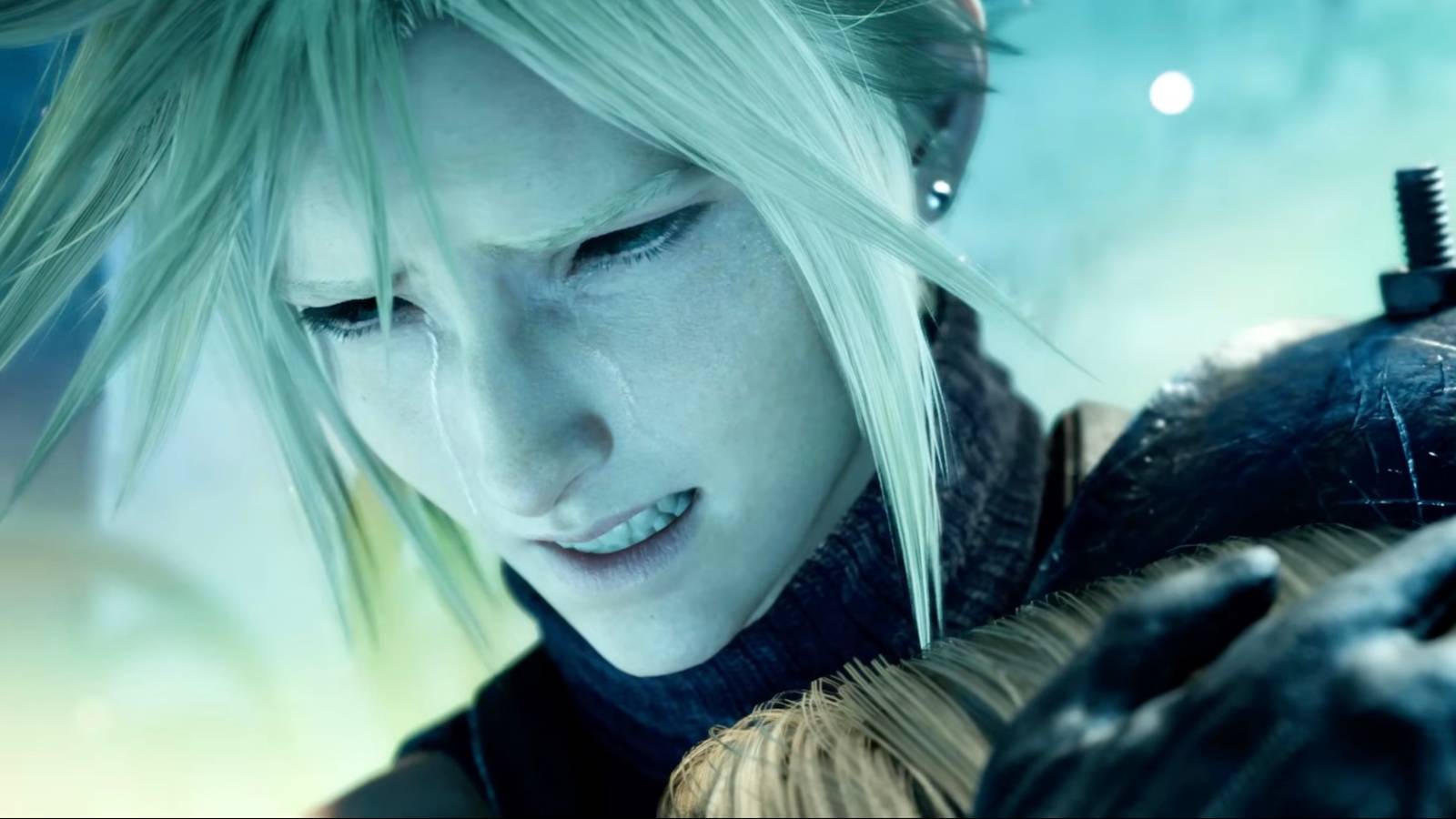
This dialogue from Cloud does not appear in 2024’s Final Fantasy 7 Rebirth. Cloud’s reaction to Aerith’s death — and the way that death is portrayed on-screen — is very different than in the original FF7. We see Cloud weeping as he holds Aerith in his arms. The audio and color shifts intermittently, and everything appears distorted and blurry. We see intercuts of Cloud saying something inaudible. Perhaps this is the “Aerith is gone” speech, but we never hear it spoken aloud.
There are some potential explanations for this omission. The Remake trilogy features full voice acting and character models that are far more expressive than the ones from the PS1 game. By integrating these sentiments into the broader context of the scene — through things like inaudible dialogue, music, and facial expressions — the creative team may be going for more of a “show, don’t tell” approach. (Maybe. I’m not totally convinced of this, given the sheer sensory overload of the cutscenes that follow.)
Aerith’s death is followed by a multi-stage boss fight, where alternate-universe versions of Aerith and the presumed-dead Zack Fair participate in lengthy battle. Afterward, we see Tifa and the rest of the party surrounding Aerith’s lifeless body. When Cloud approaches, the others disappear, and a rainbow color surrounds Cloud as he holds Aerith. He tells her to wake up, which she does, with a slow smile. There are two (or more!) versions of events playing out simultaneously at the end of Rebirth.
Next, we cut to the party sitting gloomily at the water’s edge — presumably after Aerith has been laid to rest, though we don’t actually see that happen. Cloud recalls a flash of Sephiroth striking Aerith with his sword, then suddenly she appears sitting next to him in the darkness. “I’ll see you off,” she says with a smile. They both seem perfectly content with the prospect of Aerith staying here alone, and it’s here that we realize Cloud does not seem to comprehend that Aerith is dead, even as everyone else is grieving. And thanks to all the multiverse / alternate timeline shenanigans afoot, it’s not totally clear to the player that she’s dead, either.

After the party leaves the underground city, Cloud continues to chat with Aerith outside as the party prepares to board the Highwind. “I’ll put everything I’ve got into my prayers,” she tells Cloud. “I’ll stop the meteor.” No one else is aware of her presence. If anything, the air is thick with her sudden absence. At this point, it’s not clear if Cloud is hallucinating, or if Aerith is legitimately communicating with him through the Lifestream in some way. Either way, Cloud does not experience the moment of realization marked by the “Aerith is gone” speech in the original game.
It’s possible that this moment did already happen in Remake, but Cloud refuses to remember it in detail because it’s simply too painful. (We know he’s got a knack for blocking out bad memories, thanks to the Nibelheim incident.) Perhaps in the third installment of the trilogy, when Cloud is able to accept all the events of his past, we will finally see that memory.
Or perhaps not. For better and worse, the ending of Final Fantasy 7 Rebirth insists that players have it both ways: the tragedy of Aerith’s death coexists alongside the possibility that somewhere, somehow, she is still alive. Comparing the two scenes side by side, holding back Cloud’s speech feels like pulling the punch a little bit — in my mind, Aerith won’t truly be gone until we hear Cloud admit it out loud. We still don’t know what the remake’s version of this heartbroken speech will look like, but I can’t wait to find out. Aerith’s absence in the final hours of FF7 is every bit as important as her presence in the early ones, so I can’t help but wonder how much Cloud will see of her in the trilogy’s final chapter.

The 100 greatest video game quotes of all time
It has been spoken