If David Jaumandreu is sure of one thing, it’s this: Nothing in the world beats riding high-speed rail for the first time.
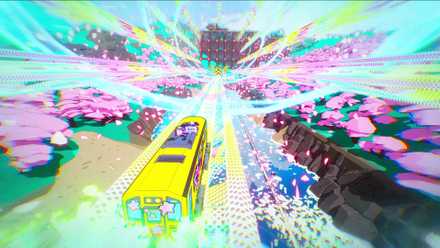
That’s the guiding ethos coursing through Denshattack!, the next game from the Barcelona-based studio Undercoders: drive trains really freakin’ fast. Denshattack!, for which Jaumandreu serves as game director, has been likened to everything from Tony Hawk’s Pro Skater to Jet Set Radio, but has enough of its own identity that it elides comparison. I can only think to describe it as the most ridiculously off-the-rails train sim ever developed.
Denshattack! is set in a dystopian future where the ongoing climate crisis has progressed to apocalyptic levels. Japan’s metropolitan areas have been transformed into domed cities, and are connected by a network of high-speed trains. (Side note: U.S. automobiles are the number-one source of transportation pollution in the world. Follow-up note: U.S. trains create 83% fewer greenhouse gas emissions than cars.) In the world of the game, so-called “Denshattackers” brave the outside world to operate trains along this network, ferrying critical supplies between cities.
Jaumandreu said he stumbled upon the concept for Denshattack! about four years ago — and by accident.
“I was playing with a toy train, a Japanese toy train, and was doing something else and just playing with it and [acting] as if it was a finger skate and saying, ‘What wouldn’t be cool if you could make tricks with a train?’” Jaumandreu said. He couldn’t shake the idea, and eventually started wondering, “‘Whoa, how would it be controlled if you did that?’”
In-game, the Denshattackers have a competitive mindset. Along the high-speed rail network, these daredevil train operators compete to see who can ride the fastest and who can look the coolest while doing it. That serves as the justification for the activity you spend most of your time in Denshattack! actually doing: kickflipping a train, just like Jaumandreu treated his toy train as if it were a Tech Deck. Underscored by anime visuals and an even more anime-inspired soundtrack (featuring Shinobi: Art of Vengeance composer Tee Lopes), most levels play out as you grind, spin, flip, wall-ride, and combo your way between Japanese megacities, all in pursuit of setting fast times and furiously high scores.
“Sharing it with the team at first, it was like, ‘Oh, this is a stupid idea,’” Jaumandreu explained. “But then we started defining how it could work, then prototyping and said, ‘Whoa, this is real fun.’”
So far, players agree. Following a wildly successful demo during Steam Next Fest earlier this year (97% positive reviews!), Denshattack! has landed on several “most anticipated” lists of new video games, including Polygon’s own. And it’s pulling into the station at the perfect time to be positioned as the game of the summer: June 17, right as the annual Summer Game Fest news cycle cools down, making way for a relatively quiet period for new video games.
While Denshattack! clearly exists in a hyper-exaggerated fiction, its train-sim elements are rooted in something real: almost every train you drive is inspired by real-life trains. And while no licenced trains appear — the way a Flip or Toy Machine deck might in Tony Hawk’s Pro Skater — Undercoders clearly has a solid enough grasp on and reverence for Japanese rolling stock to create legally distinct versions for its game. To an untrained eye (hello), the “Beppu Star” looks like a late 20th-century Kawasaki subway car. The “Sunrise Pitcher” bears resemblance to Hitachi’s N700S series (albeit with a razor blade on its cab). And each train model has varying stats in terms of how fast it goes, how efficiently it grinds, and how effectively it can perform tricks.
“We are fond of trains. We are fond of Japanese trains in particular,” Jaumandreu said. “So I guess that’s one of the reasons that Denshattack! exists — is that we are skateboard guys, we are also train guys, Japanese train guys in particular.”
Not only that, but Denshattack!’s train-sim bona fides shine through in how accurately it captures the enlightening sensation of riding a high-speed train for the first time. High-speed rail — true high-speed rail — does not exist in North America the way it does in many other parts of the world. Those of us who don’t live with it as part of daily life simply don’t know what we’re missing.

For context, in the U.S., the fastest commercial train is the “next-gen” Acela, which went into service earlier this year and can reach a top speed of 160 mph at certain points on its route. Europe’s fastest operating train, the Frecciarosa 1000 in Italy, can reach speeds of 248 mph. You can get from Florence to Milan in an hour and 40 minutes — about two hours less than it takes to take a next-gen Acela to cover roughly the same distance in the States, from New York City to Boston. Spain, where Undercoders is based, has consistently invested in high-speed rail since the early ‘90s, and now has the second-largest network in the world. By every metric, Western European countries are miles — ahem, kilometers — ahead of American countries on high-speed rail.
But even those networks pale in comparison to the fastest trains in Japan, known as Shinkansen. (The Shinkansen is sometimes referred to as the “bullet train.”) Trains operate with top speeds of 199 mph, and boast a dizzyingly efficient average delay of roughly a minute-and-a-half. Compared to almost every other high-speed rail network, trains in Japan just… work. Despite opening to the public back in 1964, if you’re coming from a country that for myriad reasons hasn’t constructed a functional high-speed rail network, riding a Shinkansen can feel like stepping into the future.
“It’s not only the trains. The whole experience? It’s mesmerizing,” Jaumandreu said. “When you go there, from the moment you enter the station, there’s this order, there’s this aesthetic to the stations, there’s the melodies — the departure melodies — there’s the shops with the bentos that you get [for] the train. There’s this whole experience. And then, of course, the trains themselves are so different, are so unique, they have this graphic design that you can easily remember: ‘This is from this area, this is from the other area.’ They are always on time. If they have any problems, they solve it quicker. So, it’s a whole experience.”

Jaumandreu talks about Japanese high-speed trains with the unmistakable gusto of a train enthusiast who knows mere words cannot capture the exuberance of riding high-speed rail. I’ve never ridden a Shinkansen, but a few years back, I rode a Frecciarosa train from Florence to Rome. Coming from America, Land of the Holy Automobile, I couldn’t believe it. And to the chagrin of my travel companions, no, I would not shut up about it: “Did you see how fast we were going?!” “Guys, can you believe we covered the distance from New York to Baltimore in half the time?!” “Wait, where are you all going? Am I stuck with this tab?”
For rail enthusiasts (we’re affectionately referred to as “foamers”), that first ride on a high-speed train borders on a religious experience. It’s like your third eye opens, reconsidering every hour wasted in highway traffic or a backed-up TSA line. All you want to do is get on the train and go really fast. That is Denshattack! in a bottle. And from what I’ve played, it doesn’t let up.
“Riding a train is fun — it’s a fun experience, and riding a high-speed train is a real fun experience,” Jaumandreu said. “It takes you places. You don’t have to care. It’s very comfortable. It’s fast. I don’t know. It’s just like… riding the train is fun!”
Denshattack! will be released June 17 for Nintendo Switch 2, PlayStation 5, Windows PC, and Xbox Series X.
12 small games that could become huge this summer
Summer 2026 is full indies you won’t want to miss

