“Why Ravenloft?” is the first question I asked Dungeons & Dragons principal game designer Wesley Schneider during our video interview. The team’s decision to go back to the game’s beloved horror setting with Ravenloft: The Horrors Within baffled many fans, including me. As I wrote in my review, this is a great sourcebook, but it’s also the remake of a popular 5th edition product, Van Richten’s Guide to Ravenloft, released just five years ago. Also, I may be a traditionalist, but having the horror entry in D&D’s new seasonal model drop in June rather than in October just feels wrong.
Schneider’s answer had more honesty than a Zone of Truth spell: “D&D is a business,” he said. “We’re always looking to do the things that we think are going to be the most resonant in the marketplace. We also make this game in constant conversation with our fans. People continue to play Curse of Strahd. Horror adventures are, I would argue, core to the D&D experience.”
Schneider said the decision was driven by both commercial realities and genuine enthusiasm from the design team. Ravenloft remains one of D&D’s most popular settings, among fans and internally among the designers. “Sometimes, we just get to do the things we really want to do,” Schneider said.
It’s hard to argue with anyone praising Ravenloft. Still, the fact remains that The Horrors Within isn’t an entirely new book. According to Schneider, the team discussed the possibility of making a new product, another big adventure similar to Curse of Strahd in scope and style. The 2024 rules revision (now officially called D&D 5.5), however, played a major role in shaping the team’s decisions. “As soon as we came off of the 2024 rules revisions, we had an incredible amount of new juice on the team, in terms of rules, art, leadership and direction,” Schneider said. The team decided to use some of that “juice” to update Ravenloft, since it’s one of the most beloved settings among fans.
Van Richten’s was surely a popular book, but it also got plenty of criticism, as Schneider reminded me. “We decided to address those things,” he said. “We’ve got these new opportunities, let’s add on what folks want, and let’s do something that feels not like a repeat of Van Richten’s, but an evolution, an iteration, and gives folks new ways to play with one of D&D’s favorite settings.”
A big change was the introduction of one of D&D 5.5’s defining traits: mini-adventures. These have appeared in every product released since the 2024 rules revision and are meant to give DMs a quick, easy-to-follow adventure outline. “One of the lovely things about The Horrors Within is that it’s full of adventures,” Schneider said. “It’s much more focused on adventure and how to play in the setting than Van Richten’s.” But how does it compare to Ravenloft’s most famous modern product and D&D’s best-selling adventure ever, Curse of Strahd?
A single adventure, no matter how big, wouldn’t play to the setting’s strengths, according to Schneider. “Ravenloft is different from other D&D settings because every Domain of Dread is a different place and horror genre,” Schneider said. “Instead of doing a single deep dive that is going to immediately be compared to Curse of Strahd, we wanted to encourage players to explore each of the settings. How do you build adventures there? What does a campaign arc here look like? What are the tools that we can give you so you can start playing here tonight?”

For example, in the crumbling domain of Dakon, most plot hooks revolve around the disappearance of its darklord, the lich Azalin Rex. The short adventure provided is significant because it’s high-level. It sends the characters (who should be level 16) to explore Azalin’s former seat of power, Castle Avernus, which is frozen in time at the moment of its explosion. Old-school fans will remember that Azalin’s grand plan to escape Ravenloft was the subject of the “Grand Conjunction” series of modules from D&D 2nd edition. Who doesn’t love continuity?
Still, many reviews of The Horrors Within coalesced around the same point: This is a great book, but if you already own Van Richten’s Guide to Ravenloft, it’s probably not worth the price tag. Schneider recognized that some players might feel that way, but he argued it was important to make the book accessible for veteran and newcomer players alike: “We must have the understanding that this might be somebody’s first Dungeons & Dragons product,” he said. “The most invested fans are going to see the similarities between the two books. What we don’t want to do is for somebody excited about horror and Ravenloft for the first time, to get this and be like, ‘Oh, and I have to buy another book from how long ago?’”
In a game that keeps evolving periodically like D&D, it’s important to provide a certain amount of foundational material every time. Still, Schneider reaffirmed that The Horrors Within is much more than an update. “This book might have the same launchpad as Van Richten’s Guide, but the trajectory of it has been different since the earliest day,” he said. “That trajectory has always been much more focused on what you can do in the setting, how to play there, and how DMs can create whole campaign arcs in the setting.”
Besides that, there is one thing that justifies buying The Horrors Within even if you already own a copy of Van Richten’s: the art. In terms of visuals, this is easily one of the best D&D products to come out in recent years. Schneider praised the work of art director AJ Hanneld.

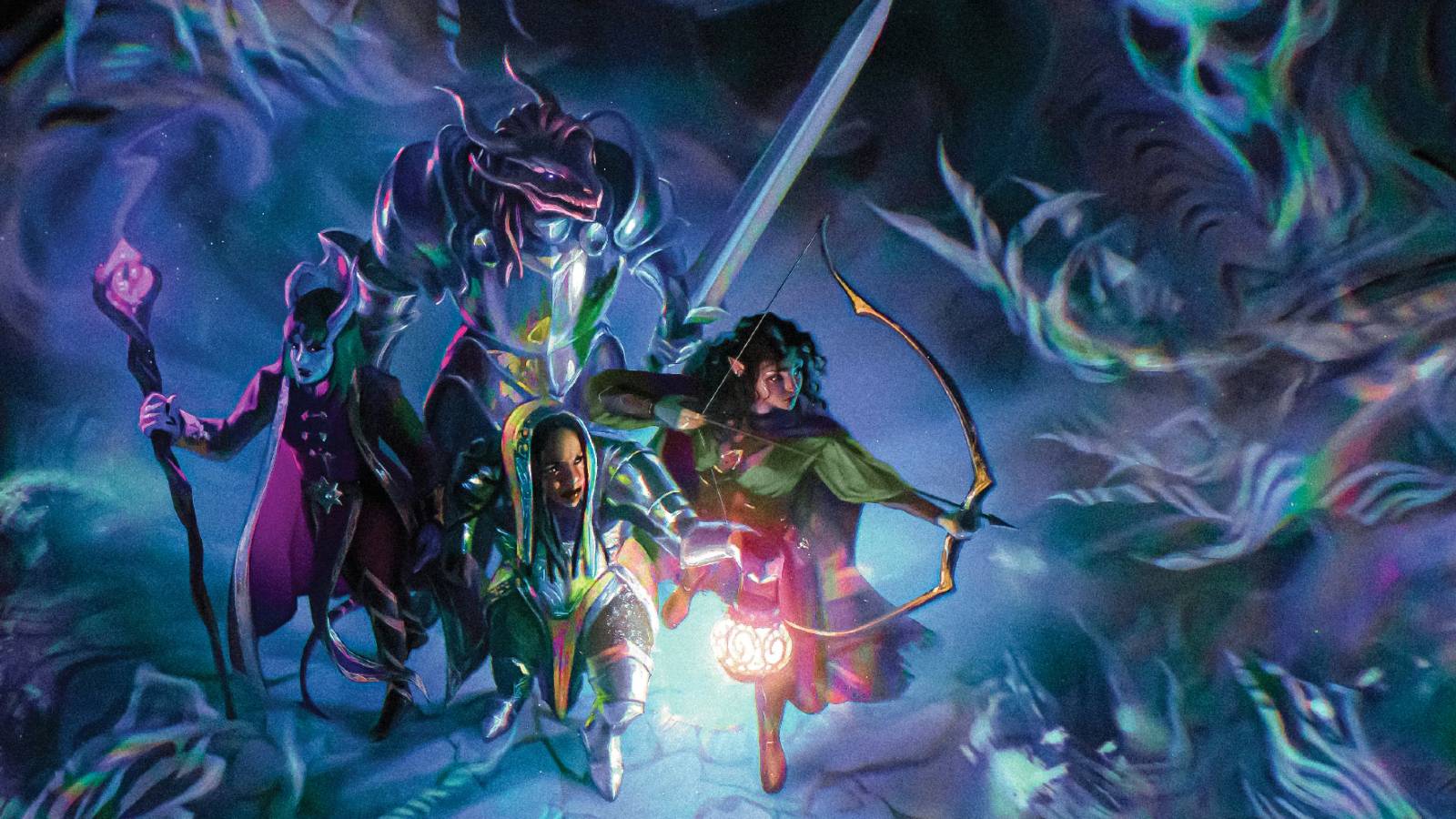
“She brought an incredible vision to this, born not just out of her own creativity, but her true deep knowledge of the horror genre,” Schneider said. “AJ did not just want to do black-and-white and red traditional gothic horror. We’ve seen it all before. She was much more inspired by modern cinema, like A24, but also J-horror. She used these lurid, unsettling colors just to really show that horror doesn’t need to be black and white.”
Just look at the illustration on page 211 for proof: It shows a Hexblood witch from Tepes, conjuring visions of all the horrible ways in which the characters could die in the future. It’s bright and colorful, but also creepy and unsettling: Would you rather be burned at the stake or pulled into the abyss by a tentacle monstrosity?
“It doesn’t need to be all Hammer horror or Nosferatu,” Schneider said. “It can be vivid in all of these distressing ways, and she brought that across all of the work of the artists who contributed to the book. She was also supported by our other art director, Emi Tanji, and our graphic designer, Trish Yocum, who have been on the team forever and are truly some of the best in the business.”

D&D’s return to Ravenloft was a deliberate choice that balanced business needs, strong fan interest, and the creative desires of the design team. “D&D isn’t a horror game, but between you and me, D&D is a horror game,” Schneider quipped. Going back to Ravenloft was a safe choice for the game’s new course, so it will be interesting to see what happens when the design team decides to brave uncharted waters.