My favourite moment in The Legend of Zelda: Link’s Awakening happens in a library. You’re wandering between the stacks, trying to learn more about this strange island you’ve washed up on, when you spy a book that’s hidden up high, stuck at the top of a book shelf, and well out of range of your grasping hands.
There’s a trick to getting that book, but really, the whole sequence is the magic of Zelda in microcosm. Here you are, there is the thing you can see and wonder about but can’t seem to reach: what do you do?
Mina the Hollower is a game in the Zelda tradition. It’s a top-down affair like the original games, and while Mina can jump, they jump just like Link does in – hey! – Link’s Awakening. They jump up into the space above the screen, as it were, and you need to use their shadow to work out where they are so you can collect things hovering about them and then stick the landing.
All great. But even more specifically, just to really drive the whole connection between games deep into your mind, at one point early on in Mina the Hollower you find yourself in a library. There’s a book high up on a shelf. You can see it, and so you really want it. But you can’t get to it. Or can you? Sure enough, there’s a trick to reaching it. It’s not the trick Zelda used, but that’s not the point. The magic that drives everything is the same magic: doesn’t that thing you can see but not reach look interesting? Have at it.
All of this makes sense. Mina the Hollower is the latest game from Yacht Club Games. This outfit’s previous series was Shovel Knight, which revisited classic NES-era platformers like Duck Tales and remade them with a lavish contemporary imagination. They were the NES games the way you remember NES games being: huge and gloriously daunting and absolutely filled with weird secrets.
Mina does the same trick, but I think it’s eyeing games like the original Legend of Zelda, and Link’s Awakening, its first Game Boy outing. It’s a game world made of screens, and while the central mechanic involves Mina’s Hollower ability to dig through the ground (collecting buried treasure as they go) and then burst out which a jump, the real challenge, and the real joy, comes from working out how the game’s endlessly complex world slots together.
This is not to say the moment-to-moment stuff is not challenging. Mina’s a fearsome beast from the off. As is standard for these sorts of things, you turn up on an island, and your job is then to move out from a central town and restore a series of doodads that are located far away in every direction. Cue exploring and dungeons and a lovely 3D-lite sequence after you’ve beaten each boss. The platforming and traversal is daunting, and not just because of the unusual top-down perspective. Mina likes to throw multiple challenges at you at once: pits you can fall into, spikes you have to remember to dig under, barriers you have to remember to jump over, and enemies, enemies everywhere: flying enemies, crawling enemies, wandering enemies, screen-filling enemies that lay down multiple attack types.
All of this is plenty of challenge. But I don’t think it’s the game’s real focus. And I say that because Mina comes with a suite of tools that allow you to dial down these moment-to-moment nightmares. You can regain health faster or knock down your enemies’ health, or you can just switch to being fully invulnerable. You can turn off fall damage and walk over pits. You can select the ability to walk over spikes! All of this comes under quality-of-life additions, incidentally, and exists a layer above the game’s other mechanics for allowing progress, which include leveling up attack and defence, selecting from a range of sidearms and equipping game-tweaking trinkets that change your basic abilities.
My point is that you can use all this quality-of-life stuff to render platforming and enemies no problem whatsoever and the game is still a beast. And this is because the sweetest, and most ingenious challenges here actually have nothing to do with enemies or platform gauntlets or even the endless parade of fascinating bosses.
Like those original Zeldas, and as that book in the library was suggesting, Mina’s whole world is one big puzzle, and it’s a puzzle where you’re constantly learning how to make even the tiniest bit of progress. In between each dungeon run you head back to the central town, for example, and there are always a handful of promising dead ends – like that book in the library – that you’ll want to have another crack at. There’s a saloon that you’re barred from. There’s a giraffe who’s head is waiting for you on an upper floor of their house. There’s a whole train station somewhere – but how to access it?
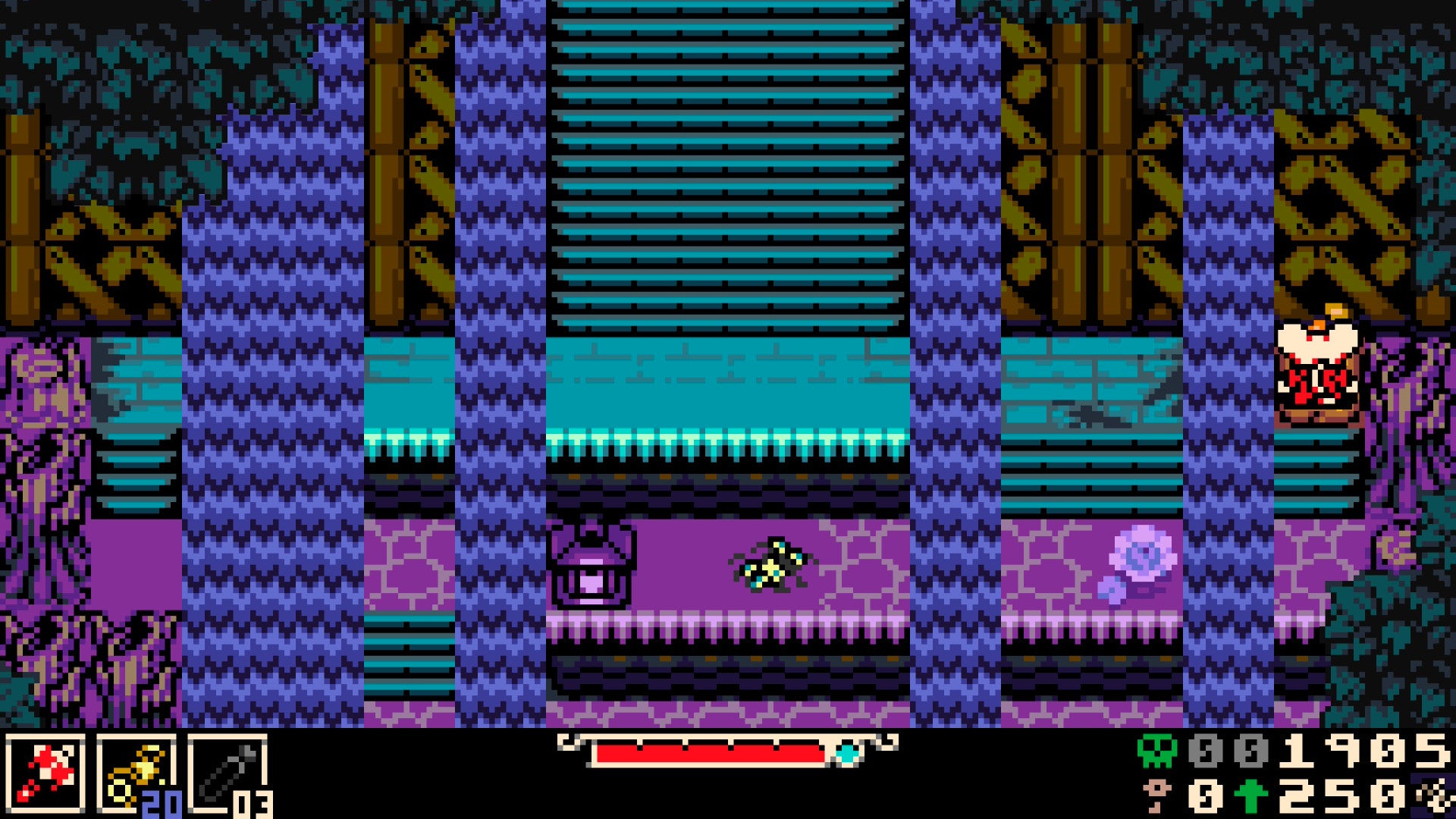
So you move around the town, you shuffle through your sidearms and trinkets, you talk to pedestrians for clues, you read the local paper, and you slowly try to work out what the game wants you to do. I spend fifteen-twenty minutes like this pretty often, just firing up Mina and having another wander around the town, talking to people, trying out moves, seeking to unlock the next part of the map and the next dungeon, the next boss, the next part of the adventure. And while you could say I’m stuck, I’m also immersed: I’m so deeply set into Mina the Hollower’s world I’m thinking about it all the time, when I’m playing and when I’m not playing.
This isn’t a review. That’s coming later in the week when a last few hurdles have fallen, when I’ve wandered and pondered and read the in-game newspaper and had a few more moments where everything has magically clicked and the path forward is suddenly so glaringly obvious I could kick myself for not thinking of it sooner. In the review I’ll get to all the details, like the ingenious enemy design – including a snake, right, that carries a knife in its mouth – and the levelling up, and the trinkets and the sidearms and the dungeons that don’t feel like dungeons and the way you level up and the secret areas you stumble across and the burrowing and the way the game approaches its map. But for now, just know this: if you ever spent ten minutes in Link’s Awakening pondering how to get to that book on the shelf, and if you loved the whole experience of that, then this game is something very special.

