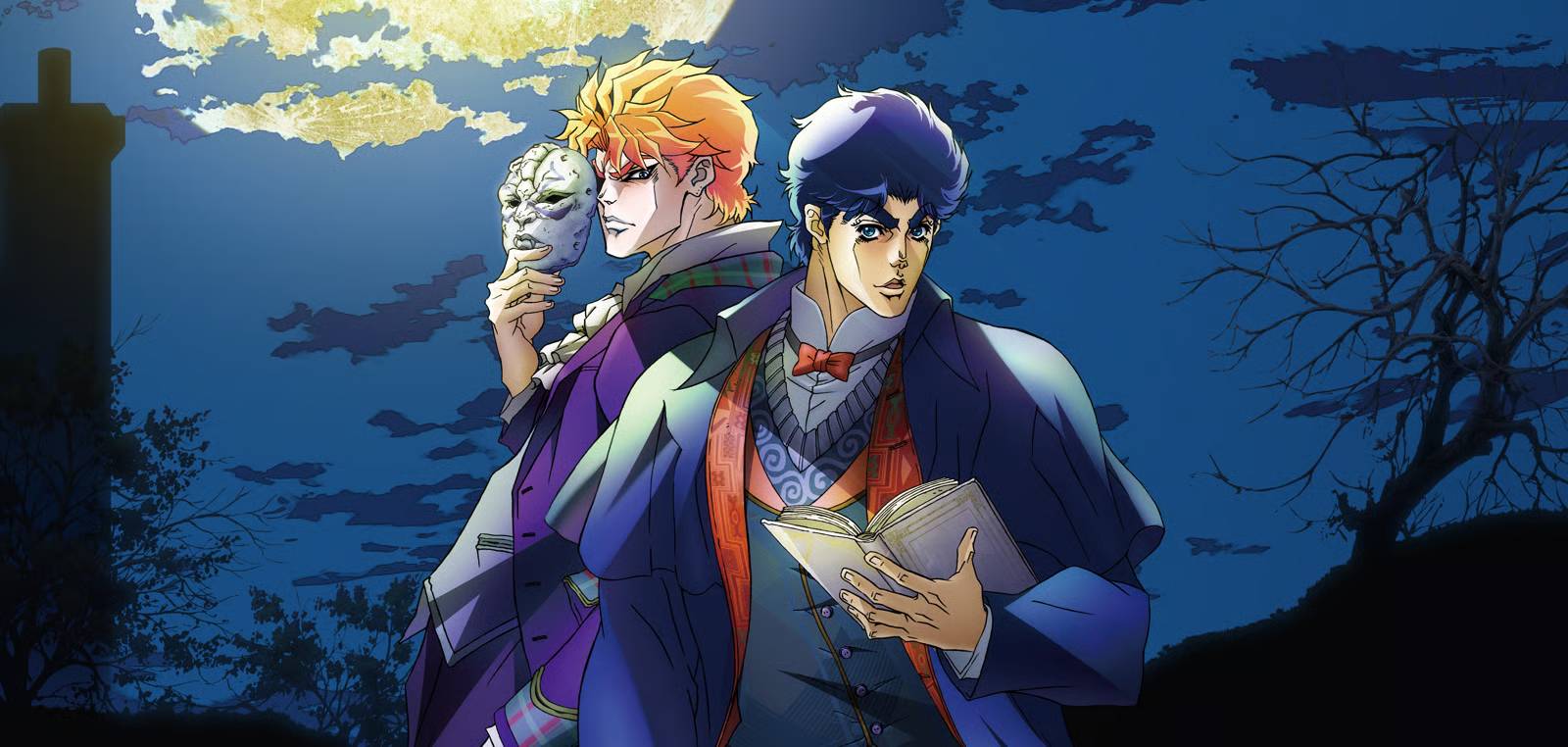
JoJo’s Bizarre Adventure has always been larger-than-life. This delightfully absurdist story about the Joestar family legacy has consistently pushed the limits of reality, space, and time.
The concept of Stands — the physical manifestation of a person’s fighting spirit — has now become the primary draw of Hirohiko Araki’s beloved manga series. But Stands were introduced in Stardust Crusaders (Part 3), allowing Araki to incorporate inventive battle mechanics and move sets that truly live up to the franchise title.
While a post-Stands JoJo-verse has undoubtedly elevated the saga to greater heights, the stories that preceded Stardust Crusaders — Phantom Blood (Part 1) and Battle Tendency (Part 2) — get overlooked due to their relatively grounded settings. The most scathing criticism of the franchise is often directed at 1987’s Phantom Blood manga, the humble origins of Araki’s magnum opus that lay the foundation for the Joestar family saga. Although this opening story has its flaws, Phantom Blood functions perfectly as an archetypal tale about good versus evil.
Set in 19th-century England, Phantom Blood opens with aristocrat George Joestar and his wife Mary getting into a carriage accident. While George lies unconscious next to his newborn child, Jonathan (who remains unscathed), a petty thief named Dario Brando attempts to steal his valuables. When George awakens during the act, he misunderstands Dario’s intentions and thanks him for saving his life. Feeling indebted to the man, George generously offers to fulfill any requests Dario might have.
After 12 years, a bedridden Dario sends his delinquent son Dio to the Joestar family mansion in an attempt to cash in on that favor before his death. Vicious and embittered due to his rough upbringing, a young Dio vows to snatch the Joestar family fortune all for himself. The only obstacle in his path is Jonathan Joestar (our first JoJo), who is the definition of a Good Samaritan. As soon as Dio steps foot inside the mansion, he brandishes his hostility towards Jonathan with unsettling tact, successfully isolating JoJo from his friends and his love interest, Erina Pendleton. George remains oblivious to Dio’s schemes, as his newly adopted son puts on the mask of a gentleman by manipulating everyone around him.

If this rivalry sounds mundane by JoJo‘s surrealistic standards, get ready for the plot to escalate to a hundred. An Aztec Stone Mask that turns its wearer into a vampire soon becomes our supernatural McGuffin. As Dio continues scheming behind Jonathan’s back, he uses the mask to gain vampiric powers, taking the story to operatic heights. Araki mixes elements of a mystery thriller and vampire horror to create a tense dynamic between these characters, who are trapped inside a Gothic mansion during a key climax.
This contained setting might feel limiting in comparison to the scope of other installments. (Stardust Crusaders features a globe-trotting adventure that culminates in Cairo, while Stone Ocean ends with the literal reset of the known universe.) Even so, Phantom Blood makes excellent use of its narrow scope by letting the Jonathan-Dio rivalry reach a feverish boiling point. There’s a comparative dearth of narrative depth here, which should be recontextualized against Araki’s decision to write Phantom Blood as a Kishōtenketsu (a four-part story structure that follows a simplistic introduction-development-twist-resolution format). This is the Eastern equivalent of Joseph Campbell’s Hero’s Journey, which also embraces a similar, quest-based format.

The Phantom Blood anime (2012) mimics Araki’s vintage art style, in which male protagonists sport exaggerated muscles while enacting dramatic poses, now dubbed JoJo poses. Araki’s inspiration for this quintessential aesthetic was Gian Lorenzo Bernini’s sculpture, Apollo and Daphne, whose intricate beauty illustrates the complex dynamic between the mythical figures. The mangaka has evolved his art style in a significant way since Part 1, having developed a more anatomically sound and detail-heavy approach that took shape in Diamond is Unbreakable (Part 4) and beyond. That said, the almost crude nature of Phantom Blood’s visual fabric lends it a vintage feel that complements the time period it is set in. It feels like a dated bubble that Dio bursts out of at the end of the story, setting the stage for him to become the primary series antagonist who eventually conquers time itself.
Jonathan dies in Phantom Blood. This is an unconventional, if risky, move for the first installment of a shonen story, which traditionally ends with the hero triumphing over his nemesis. Although Jonathan ensures that Erina (whom he marries) is safe, he sacrifices himself while gently holding Dio’s severed head on a sinking ship. While Battle Tendency features Dio’s return, Jonathan’s death is integral for the story to continue, as it helps pass the torch to our next JoJo, Joseph Joestar. Araki’s gamble pays off, as Phantom Blood celebrates the beauty of the human spirit, which is reflected in Jonathan’s boundless compassion.

This chapter is also the origin of the recurring energy-based ability named Hamon, which Araki reinterprets in the brilliant Steel Ball Run that follows a different continuity than the first six installments. Perhaps the glaring flaw of Phantom Blood is that it isn’t meatier, and should’ve spent more time fleshing out its fantasy mechanics. Spending more time with iconic characters like Baron Zeppeli and a young Speedwagon would be a welcome prospect, which could also let Jonathan evolve beyond his “lawful good” moral alignment.
Nonetheless, Phantom Blood is the irreplaceable cornerstone of JoJo’s Bizarre Adventure. Skipping Part 1 is like pressing fast-forward to watch an epic battle without comprehending what prompted it in the first place. This bizarre journey only gets wilder from here on, but there will never be another JoJo like Jonathan, who remains “heroic and merciful” until the very end.
JoJo’s Bizarre Adventure: Phantom Blood can be streamed on Netflix and Crunchyroll.