How did a nine-year-old game about competitive pottery get resurrected as Psychonauts 2 developer Double Fine’s next game? “I’m still trying to figure that out,” says Derek Brand, project lead on Double Fine’s new game Kiln.
Kiln, out Thursday, was first prototyped back in 2017 as part of Double Fine’s recurring Amnesia Fortnight event, during which developers at the studio pitch new game concepts. That year, 25 game pitches were considered. Kiln’s concept was “a multiplayer, team-based brawler with a focus on creating unique player sculpted characters featuring crazy physics-based animation and destruction.” Brand’s pitch for Kiln wound up being the team pick at that year’s Amnesia Fortnight.
“At least internally, people really loved it,” Brand tells Polygon. “We found some kind of magic in that prototype that got people playing it a lot, even past Amnesia Fortnight. It just felt like it was in the air, I guess.”
But the realities of game development meant that Kiln’s journey from pitch to wide release took nearly a decade. Brand worked as the lead artist on 2019’s RAD and as concept artist on 2021’s Psychonauts 2 in between, but Kiln endured as a concept that the Double Fine team loved.
“Since we were working on this during COVID too, and the team is pretty hybrid, it was a great way to keep the team communicating and together,” Brand says.
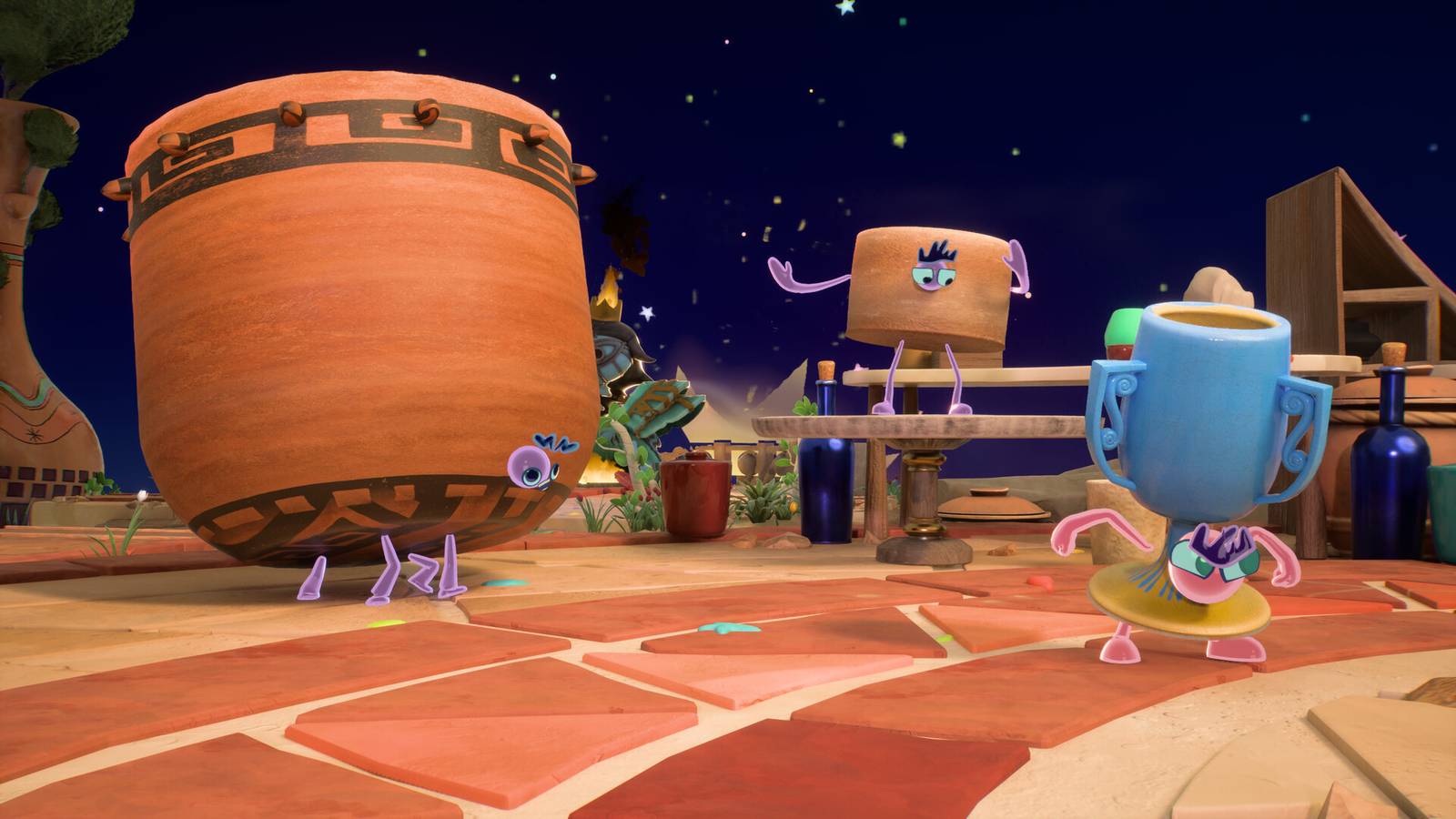
In Kiln, players make custom pottery — bowls, jugs, vases — of varying sizes who become warriors on a multiplayer battlefield. Players’ ceramic vessels carry water in their bodies as they fight to extinguish their opponent’s kiln (and protect their own), and meet in mortal combat, battling with fists and special abilities. Kiln is as much about creative expression as it is about smashing your enemies.
“The whole idea came from: I want to make weird little guys, and I want someone else to make weird little guys, and I wanted those guys to fight,” Brand says. “The more we learned about pottery and learned about that art and craft, the more it felt like we really wanted to use this as an opportunity to share the craft and the art to more people. The creation aspect [of pottery] can be intimidating to people, especially in our earlier prototypes when we were sitting people down, and they’re like, ‘I don’t know what to make. This is hard.’”
Making pottery in Kiln is far easier than it is in real life. Throwing and sculpting clay on a wheel is much harder than it looks, in my own experience. You’re always just seconds away from disaster or starting over when making pottery, to say nothing of the kiln-firing process itself, where pots can often crack or explode.
The developers of Kiln smartly simplified the process. Players start with three size options for their clay, letting them make tank-sized pots, medium-sized all-rounders, or speedy little creations. Based on what players sculpt, the game buckets their creation into one of eight archetypes.
“Your speed and health and your maximum [water] capacity is determined by those clay balls, which size you’re going to choose,” Brand explains. “Then you can shape that into a number of shapes. We have eight total detectable shapes on the wheel […] and it turned out that eight was a good number. As you’re sculpting, we detect what you’ve made…
“If it’s really flared at the top, this is a bowl, or if it’s flared at the bottom, this is a jug. We have chalices and vases, and… we’ve had a lot of ‘What is a sandwich?’ conversations about what’s a bowl, what’s a bowl, what’s a jug.”
Your pottery’s special abilities are governed by their shape, as is the “personality” of your pot.
“You’re making these trade-offs: Do I want to be more objective-focused? Do I want to fill up with a bunch of water, but have less health? Or do I want to be more health-focused and be able to do less damage to the objective?” Brand says. “So you have all these big choices that you have to make for each pot that you’re making.”

But the goal is not deep pottery simulation, Brand says. Kiln is meant to unlock the creativity inside players, letting them decorate with glazes and stickers to express themselves. It’s also meant to give players the visceral thrill of seeing their pots smash and be smashed.
“[Kiln] is the most fun when it is a pottery power fantasy,” Brand says. “I’ve been saying that a lot. So it should feel like this is unlocking your creativity. This is a way to do whatever you want and make whatever you want, and the game enables you to do that.
“This is not a hardcore pottery simulator. It’s the Cruisi’n USA version of [pottery]. It’s not the hardcore Forza Motorsport version. We want it to feel arcadey and fun and easy while still introducing as much of real pottery as possible, inspiring you to feel like you’re in this pottery studio and that you kind of know how to do it by playing the game.”
Kiln will be released on April 23 on PlayStation 5, Windows PC, and Xbox Series X. Brand says that additional content, including new cosmetics, stickers, and game modes, are in development and will be released over time.

The best video game documentary ever just got better
Double Fine PsychOdyssey adds a 90-minute prologue and a Blu-ray release