You’ve heard this story before: The Demon King (“Ma-oh”) is the evil lord that rules over monsters in a darkened land; the Hero (“Yuusha”) is the chosen champion of humanity, the only one with the power and courage to defeat evil and bring peace to the kingdom.
It’s one of the most ubiquitous tropes in Japanese media, born from a mix of local mythology (the Mara from Buddhism, the legend of Momotaro), Japanese history (Oda Nobunaga was known as “the demon king”), Western influences, and more recent media (the Dragon Quest video games series in particular is credited for starting this trend). It’s so overused in manga and anime that, with the notable exception of Frieren, I didn’t think it was possible to make it interesting again.
I was wrong.
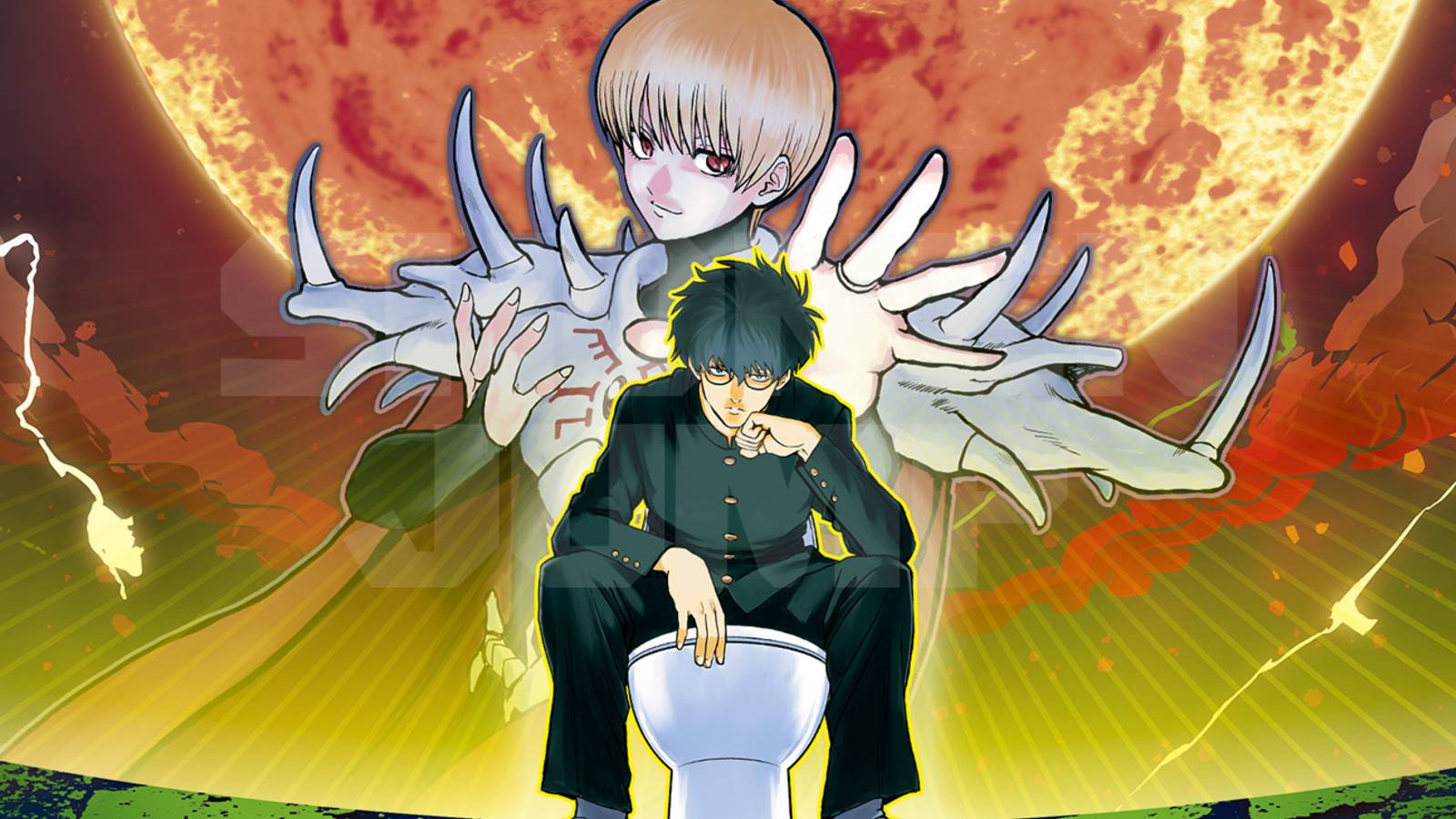
After eight years of absence, Gintama author Hideaki Sorachi returned to Shueisha’s flagship manga magazine, Weekly Shonen Jump, with a new serialization titled Class 2-B Hero Destroyerz. Having somehow missed the announcement, I didn’t immediately realize what I was reading when, on April 19, I opened the first chapter in the Manga Plus app. Seeing a Hero and Demon King mentioned in the first two pages, I rolled my eyes and thought, “Here we go again,” before the titular lord of darkness popped her head out of a toilet in a Japanese high school bathroom. Now that’s different.
Everything clicked when I looked at the author’s name again and realized that Sorachi was back to grace our lives with more of the meta-humor and bizarre comedy that made Gintama one of the best-selling manga of all time. The popular series lasted for sixteen years and produced an anime adaptation, movies, and even two live-action films. One of Gintama’s funniest elements was its constant satire of popular manga and anime tropes, and it’s clear that Sorachi’s new work follows in those footsteps (and not just because the manga immediately zeroes in on the “long shoulder pads” jokes).
Class 2-B Hero Destroyerz begins with Demon King Valaris facing imminent defeat from the Hero. However, he took the precaution of creating a clone, Valaris 3, and infusing her with his power, before sending her away through a secret passage, which turns out to be a dimensional rift leading to the above-mentioned toiled stall in Shinkai Academy. Valaris 3, who doesn’t have much control over her powers, decides to blend in at the school through illusions and wait until she has gathered enough evil minions to go back to her world and face the Hero. She meets Akira Kumon, a newcomer, who looks plain and bookish but is actually a legendary delinquent known as Demon King Commode.
The premise doesn’t sound too absurd until you learn that Valaris 3 — by the way, no mention of a Valaris 2! — is a complete klutz who acts aloof while falling on the stairs and getting her face smashed during volleyball. Kumon, on the other hand, has left his delinquent past behind and is trying to cage the “dark beast” that sleeps inside him… which turns out to be, and there’s no delicate way of saying this, his poop.
Kumon’s dream in life is “taking a dump in peace,” but every time he tries to do that at school, some punks get in the way, forcing him to smash their faces into urinals.

Gintama fans know that Sorachi is big on toilet jokes, but I would have never expected this to be the whole premise of his new series. Still, Class 2-B Hero Destroyerz is a breath of fresh air (pun intended) for Shonen Jump. While the magazine has had some good comedy series over the past few years, they never managed to break through the glass ceiling. Sorachi’s trademark brand of meta-humor was sorely missed, but it’s his ability to blend gag comedy with relatable characters and longer plotlines that made Gintama a success. The same elements shine in the first chapter of Class 2-B Hero Destroyerz.
Some of the most popular Gintama skits feature the characters referencing or parodying other popular shonen series, like Dragon Ball and One Piece. It transmitted a sense of creative freedom and an “everything goes” approach that made many fans fall in love with Gintama. Sorachi’s new manga focuses on two ubiquitous tropes: the Demon King vs. Hero setup and the “yanki” (young delinquent) stories set in high school. With manga and anime being everywhere nowadays, their tendency to go back to the same creative wells can create a sense of exhaustion among fans. Frieren proved that familiar tropes can be used to craft an original and compelling story. Class 2-B Hero Destroyerz, instead, shows that a talented author can take those same tropes and turn them into comedy gold.
At a time when Shonen Jump is still in the process of rebuilding a strong lineup after massively popular series like Jujutsu Kaisen and My Hero Academia ended, Hideaki Sorachi’s return is what the magazine needed. It’s hard to predict if Class 2-B Hero Destroyerz will reach the same heights as Gintama, but I’ll be there for the ride, and to learn if Kumon will ever achieve his dream of peacefully taking a toilet break at school.