Steven Spielberg has spent more than half a century creating some of the most recognizable images in cinema history. And many less recognizable images that bolster the more recognizable ones. [Saw voice] Let’s play a game.
Disclosure Day, Spielberg’s latest, is a great excuse as any to revisit one of the most expansive and eclectic directorial filmographies ever assembled. Also I love a quiz that I am bad at. I hope you do too.
70 snapshots from a 50-year career.
Which Spielberg movie is this?
Final Score
0 / 70
What struck me while putting together this exhaustive multiple-choice test — painstakingly selecting screenshots from across Spielberg’s entire feature-directing career, and feeling guilty about leaving out the remarkable TV movies and episodes he made in those formative early years — is how his filmography manages to embody both continuity and constant reinvention. There is an unmistakable Spielbergian cinematic language, and yet he has never really repeated himself. He rarely bends to the expectations of genre, even as he glides effortlessly through the slipstreams created by the filmmakers who inspired him.
Example: After The Fabelmans, it’s hard not to hear David Lynch’s John Ford barking at the young Spielberg surrogate to never place the horizon in the dead center of the frame. The real Spielberg clearly took that lesson to heart. You’ll see horizons framed up high and framed down level. Never in the middle! In adhering to rules, he also made his own. Historical epics made decades apart seem to echo one another. His commitment to shooting on film gives much of his work a timeless quality, even as advancements in cameras, visual effects, and filmmaking technology keep the movies feeling modern. I would classify him as a defiant rebel ready to walk across uncharted waters with every picture.
When it comes to the artisans who breathe deeper life into Spielberg’s films, cinephiles naturally gravitate toward John Williams, whose music has become inseparable from the filmmaker’s work. But mute a Spielberg movie and you still know who made it. You couldn’t build a “Guess That Steven Spielberg Movie” quiz around the many immitators who’ve chased “Amblin-esque” sensibility over the last four decades and expect the same result.
That distinctiveness stems partly from Spielberg leveraging box office success for influence and budget resources, but it also reflects the remarkable collaborators he’s chosen throughout his career. There is no Spielberg movie without cinematographer Janusz Kamiński, editor Michael Kahn, production designer Rick Carter, producers Kathleen Kennedy and Frank Marshall, and the many other legends of craft who have helped transform dreams into reality.
Dreams are the operative word. As you move through Spielberg’s films, you’ll find a filmmaker whose imagination pulls fantasy closer to reality while turning the violence and wonder of everyday life into something that feels half remembered, half dreamed. Everything exists in the peculiar space where filmmaking transforms artifice into emotional truth. I am not talking about the Backrooms — I’m talking about the dream state of cinema. In his most overtly fantastical work (I see you, Ready Player One) he strives for a kind of authenticity. Yet even a “dry” film like Lincoln has a Michael Critchton-esque snap for entertaining. Spielberg doesn’t send us scrambling to Wikipedia for a fact check, fact or fiction. He’s just out to raise the hair on your arms and linger in your memory.
There are plenty of obvious Spielberg images we couldn’t celebrate in quiz form: iconic “Spielberg faces,” the breathtaking landscapes, the action sequences so indelible they practically justified the invention of the pause and rewind buttons. Instead, we wanted to go deeper. We wanted to make it hard.
How well do you know Spielberg? Probably not this well. But that’s part of the fun. Few filmmakers have offered this much variety over the course of a single career. Tell us your score and be honest!!
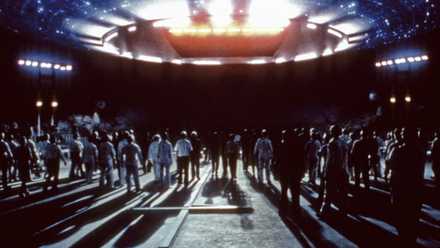
Close Encounters is Spielberg at his weirdest, most personal, and best
The 1977 UFO epic is both nightmarish and ecstatic

