When director Taika Waititi reinvented the character of Thor Odinson with Thor: Ragnarok, he also made the choice to cast himself as the voice of Korg, a friendly alien made of rock. Since then, Waititi has leant his distinct, New Zealand accented-voice to a number of animated and computer-generated characters. In addition to a role in the Pixar film Lightyear, he’s appeared on both The Simpsons and Rick and Morty. He also voiced the assassin droid IG-11 in The Mandalorian.
Yet as enjoyable as those characters have been, playing the stop-motion rabbit Ralph in the 2021 short film Save Ralph is perhaps his most important voice-acting role.
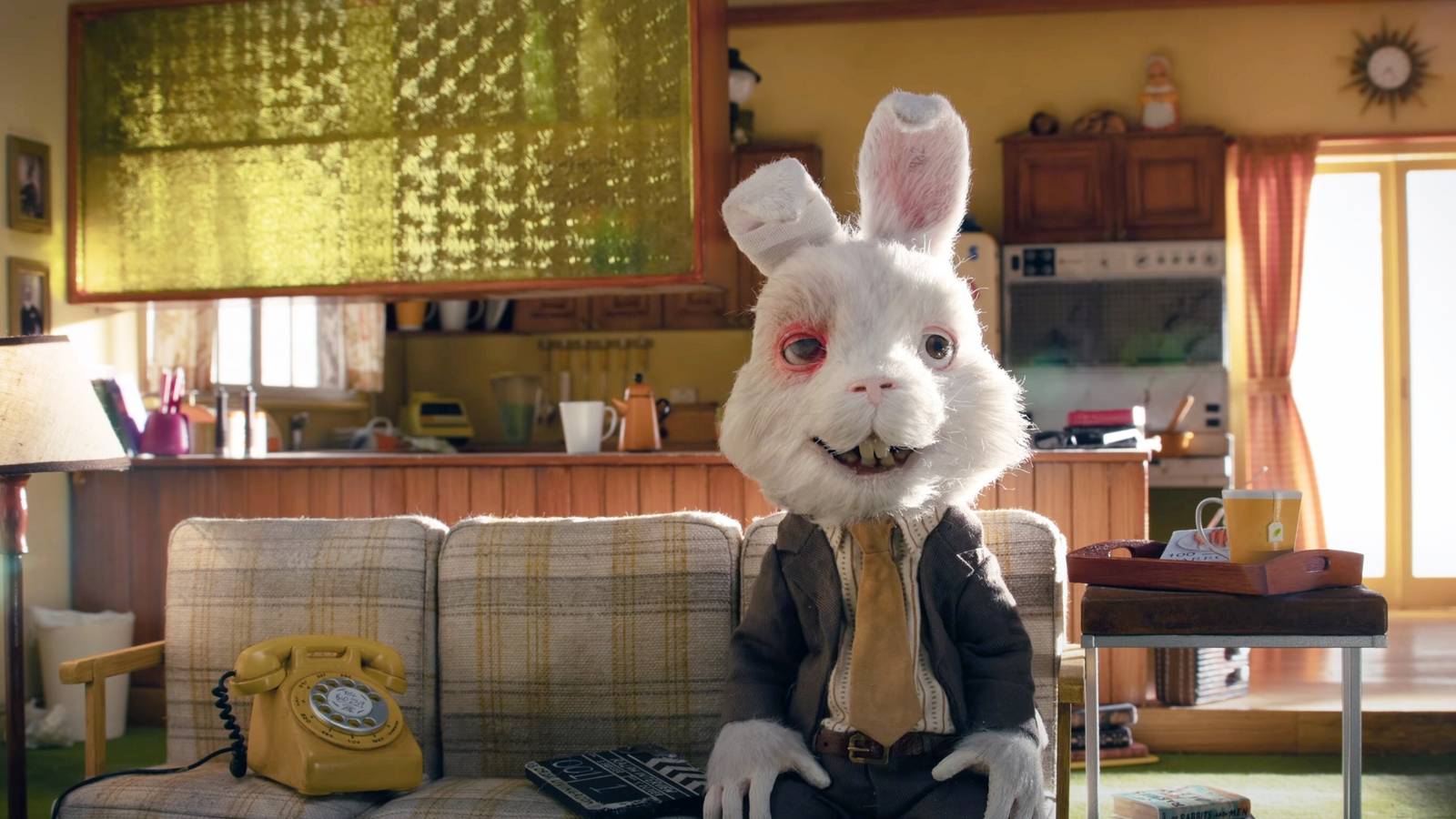
Save Ralph is a four-minute short that begins like a documentary, with the subject talking to the camera. We meet Ralph, a cute white bunny with a bandage on his ear and one blind eye. Before long, Ralph begins talking about how he’s half-blind and how his one ear only hears ringing. He also talks about getting his fur shaved and receiving chemical burns down his back. “I’m a tester,” he explains with matter-of-fact normalcy.
Then, a huge human hand bursts through the ceiling of his cute little house and places Ralph into a glass box alongside other rabbits begging for freedom. The human hands inject something into Ralph’s good eye. In the final scene, we see Ralph in the bunny locker room in a neckbrace, now blind in both eyes. He thanks the audience for using animal-tested cosmetics. Otherwise, he says, “I’d be out of a job.”

Sponsored by the Humane Society International (now Humane World for Animals), Save Ralph was written and directed by Spenser Susser, who spoke with Polygon for the fifth anniversary of the short. “I got a call from a friend. He knew the guys at the Humane Society International and they were looking to do something to bring awareness to cosmetic animal testing and they didn’t really have any ideas” recalls Susser.
While on the phone with his friend, Susser came up with the idea of a rabbit talking to the camera about what his life is like. Soon after, he was asked to write the short and came on as director.
“I’ve been vegan for many years and I’ve always felt like there was something more I could do,” Susser says. “I always wanted to make something, I just didn’t know what. This felt like a really good opportunity to give a voice to the animals that don’t have a voice.”
Before getting started, Susser wasn’t that familiar with the kinds of tests that are being performed on animals for human cosmetics. “I was shocked at the fact that this is still happening,” he says. “I learned a lot about it and some of the things that they do to the animals. I’ll give you an example with rabbits. They do a lot of putting things in rabbit’s eyes because rabbits don’t have tear ducts, so they can’t blink it out. So when they put chemicals in their eyes, they just sit there and burn holes in their eyes.” He also notes that, with modern science, this kind of testing isn’t necessary anymore. “You don’t need to torture an animal to realize something’s not safe.”
But with such heavy subject matter, people tend to look away when they’re shown the kinds of things that are happening. “I felt like it was important to find a way in,” says Susser. “I thought, if I made this friendly character that you like and he kind of slowly invites you in, you’ll get invested in him. Then, by the time you’re paying attention, you start to realize what’s going on.”
Susser knew from the start that he wanted to work in stop-motion animation for this project.
“[Cartoons] feel like a different category in your brain,” he says. “You just go, ‘Oh, that’s a cartoon.’ But stop-motion is real. They’re real existing characters. They’re tactile.”
While a stop-motion feature film might need many puppets of the same character, just one Ralph was needed for Save Ralph. He was built by Andy Gent who previously worked on Coraline and Fantastic Mr. Fox.
“One of the most important things was that Ralph could emote so that you could lean in and feel him,” says Susser. “I knew I wanted him to have bigger eyes so that you could see into his soul, if you will. Then, with that one blind eye, that was like a battlescar. Ralph’s a positive guy, but he’s been through it. He’s been blinded before. It was something to make you lean in and go, ‘Ooh, there’s more of a story here.’”

Production of Save Ralph occurred during the pandemic, with Susser in LA and later Australia while his film was being animated in England by Tobias Fouracre, the project’s sole animator. Fouracre worked from Susser’s storyboards, audio scratch tracks done by Susser, and the recording sessions Susser had conducted with his friend Taika Waititi. Susser and Fouracre would meet via Zoom a few times a day for a shoot that lasted 50 days.
“On a good day, we’d do about three seconds.” says Susser.
While the process was slow, Susser says it was smooth and enjoyable, with the biggest hiccup coming after they’d completed it.
“At one point, Humane Society International felt like it should only be 60 seconds,” recalls Susser. “After I had made the film, they said, based on their research, people would only watch 60 seconds. I strongly disagreed. I felt like, if it’s entertaining, people will watch. We had quite a bit of back and forth and I said, ‘Look, let us just release it as it is. If it doesn’t catch on, then by all means, cut it down.’ To their credit, they let me do that and it caught on right away, so they never brought up the shorter version again.”

At present, the YouTube upload of Save Ralph has 17 million views. It also was awarded at a variety of film festivals and was shortlisted for an Oscar. Still, its impact went much farther than views.
“Save Ralph inspired millions of people to sign petitions, check their own beauty products, and demand change from lawmakers and companies,” says Susser. “Most importantly, it helped pass bans on cosmetic animal testing in four countries: Canada, Mexico, Brazil, and Chile. People really got behind the message.”
Susser hopes that more countries, like the US, will follow suit in banning animal testing for cosmetics. Still, he says he’s seen progress in the way people think about the subject.
“It’s been great to get people to just look at their beauty products and go, ‘Oh, this is tested on animals. No thanks.’ Because there’s plenty of other options.”