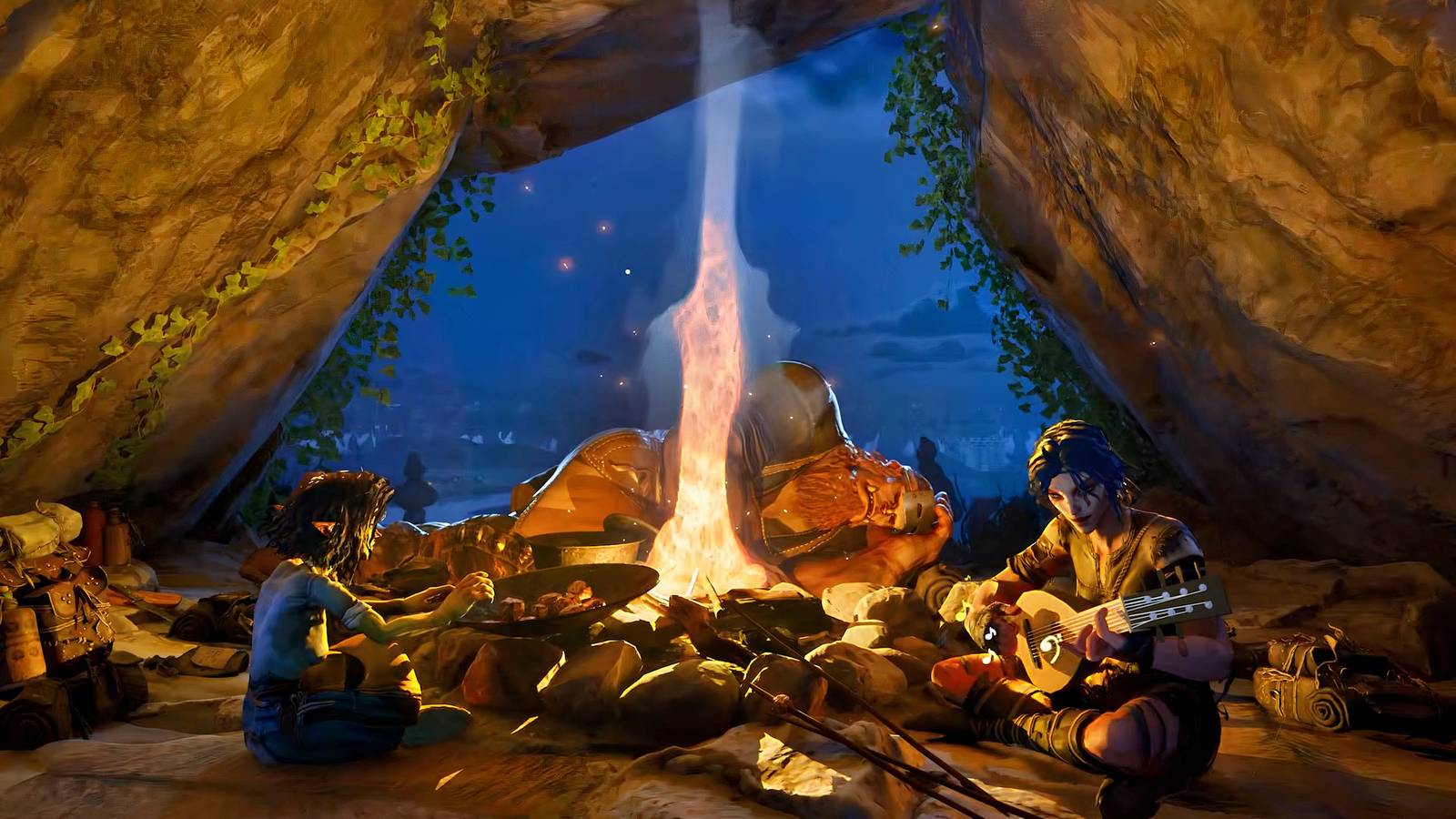
“What’s a ‘Gong Farmer’?” I asked Dennis Brännvall, the creative director of Star Wars: Battlefront and co-founder of Wayfinder Studios. We were chatting as I started playing Wayfinder’s upcoming co-op action RPG Wyldheart. One of the first decisions the game presents you is a riff on a classic: selecting your character’s very, very humble background.
“That’s the person in charge of the latrines,” he said delicately, chuckling a little bit.
Thus, Arlo Mossgrave (a randomly rolled name) was born, a Hobbit-like Mossling peasant who spent his nights shoveling other people’s poop in a small village with his trusty pitchfork. Within moments of pressing the start button, Wyldheart telegraphs that you are the lowest of the low using Middle English terminology like “Scullion,” “Drover,” and my beloved “Gong Farmer.” (I’ll admit I was also tempted by “Rat Catcher,” “Grave Robber,” and “Drunk.”) So often in RPGs like this, backgrounds feel painfully generic, so rather than roleplay, we tend to go for optimization instead and wind up googling “wyldheart best character background.” Something about this novel approach got my role-playing gears spinning instead. Very quickly, Arlo came to life in my mind in the same way that all my Dungeons & Dragons characters do.
Brännvall explained that while choices like ancestry and background don’t have much of a long-term impact on gameplay, they do determine your starting gear and skill trees.
“If you’re a Baker, you might get a starting point in cooking, for example,” he said. “The Exiled Noble starts with an ornate sword and a point in swordplay.” The Drunk’s broken bottle is a surprisingly effective one-handed starting weapon. Nearby, Wayfinder CEO and co-founder Fia Tjernberg commented that she liked the Grave Robber’s two-handed shovel the best.
Arlo woke up in a dark dungeon dripping with green slime clusters — he was truly in deep shit this time. Thankfully, he arrived with a torch (Gong Farmers work at night!). I was able to light it on a nearby sconce just by walking up to it, grateful I didn’t have to press any buttons to do so. “If you’re playing with another friend, you can light each other’s torches and stuff like that,” Tjernberg said.
Inside every sludge pile I found was the decaying remains of dozens or perhaps hundreds of previous peasants who’d also been tossed in here. Each had several pieces of gear to swap out, offering me a way to test out various kinds of weapons and playstyles. I lucked out and found a mace in the very first pile, something the devs said was a top-tier early weapon. Within minutes, Arlo was decked out in a robe and feathered cap with a mix of heavy and light weapons.
The dungeon had a mix of undead and small green ooze monsters, which made me realize that different weapons delivered different damage types. “The zombies are surprisingly good at taking crushing damage,” Brännvall said. “So there’s a bit of discovery in like, ‘What should I use against what enemy?’” Slash and pierce attacks went right through the ooze, dealing less damage, so the mace came in really handy for smashing them. Every weapon has limited durability as well, so I imagine that players will have to frequently swap between weapons when playing for more than one reason.
Combat feels reminiscent of games like Fable or Kingdoms of Amalur: The Reckoning where you’re swapping between weapons on the fly, managing your stamina as you attack, block, and dodge around enemies. In one encounter, I came up against a slime, a cultist mage, and her skeleton guard with a sword and shield. The mage had an area-of-effect poison cloud spell and teleported around the battlefield, but I focused all of my attacks on her, dodging out of the way whenever she cast her spell. (Brännvall noted that a lot of players die in this encounter by targeting one of the other two first.) Kicking at the skeleton helped to break its shielded guard stance.
But just before she died, the cultist shrieked, and another skeleton came running in. Wyldheart features a noise mechanic where enemies can call for reinforcements in this way. So if you spend your time in dungeons bumbling around and making a lot of noise, you’re likely to attract attention. In some cases, you can barricade doors behind you.
Speaking of doors: I almost fell out of my seat in surprise when a skeleton swung an axe at me as soon as I opened a random door. Later, I encountered more enemies, a few puzzles that felt just hard enough, and eventually found my way to the dungeon’s final boss: a huge slime monster that hurled acid blasts, flanked by a handful of small slimes. I whimpered a bit — one of my favorite D&D characters ever, an artificer named Khatska who wielded a magical spear, died a few years back after she was dissolved in a slime.

Brännvall was sympathetic when I mentioned it and offered me a tip to ease my trauma: light the braziers lining the outer edges of the room and hurl them at the boss for major damage. Though Arlo did die once on account of standing in the ooze’s body too long smacking it with my mace, I returned to throw another brazier and was able to exit the dungeon out into the vibrant fallen Kingdom of Caerwyn.
The bigger picture and world
Wyldheart is a crossplay co-op RPG built for up to four players at a time, but each campaign can support a much larger group. Up to 20 characters can exist within a single shared world, letting friends drop in and out between sessions without derailing the adventure. It’s a structure designed around a familiar truth: the real final boss of any RPG isn’t the dungeon — it’s scheduling. Even from a storytelling perspective, the game is designed to support this glaring truth about playing RPGs with your friends. XP is shared amongst the entire group.
“There’s a curse from the Fey world and a mist that’s creeping into all the corners of the land,” Brännvall explained. “You need to find up to seven relics and bring them to the main hub of the town in the middle of the land to activate the wards. So it’s cause for celebration when you find one during a session, but you can still play it async if you want.” Even if a member of your adventuring group misses out on the story mission to acquire a relic, there are still six more — so they’re really not missing out on all that much. But there’s also so much to do in the larger world exploring the overworld map that you can always come back to story missions later.
“This is very much an homage to old-school RPGs like Dungeon Crawl Classics,” Brännvall said.
Wyldheart is structured as a series of “bite-sized” campaigns meant to take about 10-15 hours. The 1.0 version of the game will have four campaigns. The first focuses on finding these seven relics to activate the wards, but it seems like most or all of the campaign’s 250 overworld hexes — which are handcrafted — has something to investigate. “This is where the game turns into a good-ole RPG hex crawl … almost like a board game,” Brännvall said.

We had just enough time to reach the game’s first village and talk to a couple of NPCs who offered some commentary and complaints that hinted at potential questlines. Brännvall explained that the game features weather systems and a day/night cycle, both of which have an impact on NPC schedules. But everyone has their own concerns and goals that help to shape Wyldheart’s overall experience.
One of the more striking things about Wyldheart is its tone. Brännvall said while it’s not quite like Darkest Dungeon, the team has aimed for a sort of “gallows humor” that is dark and grim but also ironic and, at times, pretty silly. At one point in the dungeon, you have to fill a skull cup up with acid to then pour it somewhere else. Technically, you can drink it instead. Similarly, in addition to potions for healing, there are also various concoctions meant to be thrown at enemies. Yet there’s nothing stopping you from drinking that either — or throwing it at your friends for the laughs.
I commented to Brännvall that Wyldheart feels a lot like co-op Fable, which he agreed with. I hesitated before adding that it’s a “friendslop” game I can’t wait to play with my D&D crew. He laughed and admitted internally they’ve bandied that term about a great deal. “We’ve been talking about this a few times!” he said. “Is it insulting to call an RPG friendslop?”
Brännvall likened sessions of Wyldheart to playing D&D one-shots. Players might try to get through it in a single evening, maybe two, and if one player or everybody dies, they can always just roll up a brand-new Gong Farmer and give it another go.
Wayfinder Studios — an indie studio with only 10 developers — expects to launch Wyldheart in early access sometime later this year.