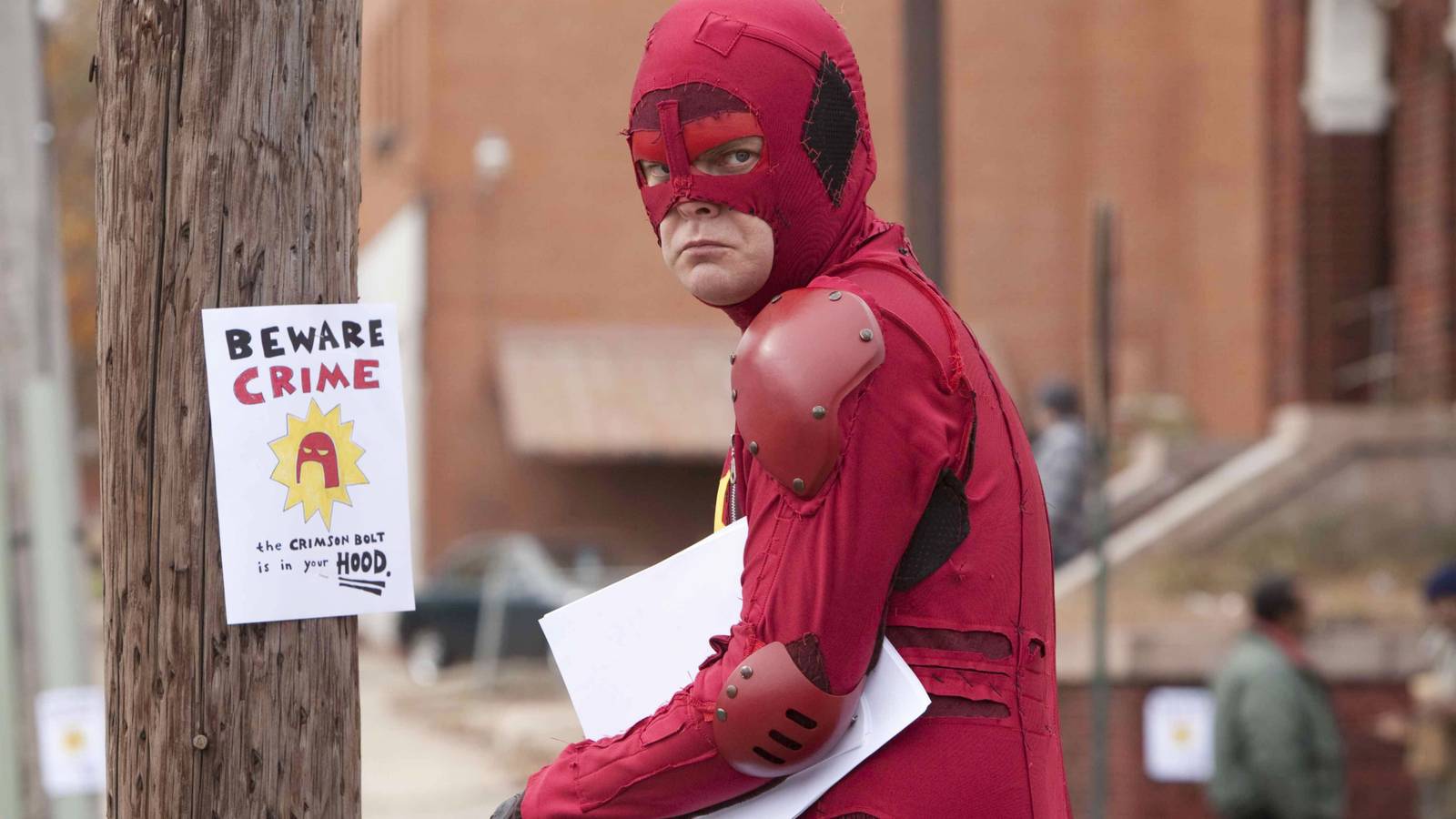
Before James Gunn got to play in the Marvel and DC sandboxes, he made up his own hero in 2011’s superhero parody Super. Released 15 years ago in early April, 2011, the movie stars Rainn Wilson as Frank Darbo, a religious short-order cook whose wife leaves him after she gets back into drugs. Feeling lost, Frank ends up having a vision where he’s touched by the hand of God and decides to help his fellow man by becoming a crimefighter. Wearing an obviously homemade, bright red costume, he adopts the persona “The Crimson Bolt” and begins running around hitting bad guys — like drug dealers, pedophiles, and movie theater line cutters — with a giant wrench.
While Gunn put his own violently funny spin on things, much of what is parodied in Super has been similarly mocked elsewhere in The Tick, Flaming Carrot, The Boys, and many others. There is, however, one recurring element in superhero media that Super examines and lampoons better than any other send up: Super seems to be the only superhero parody that fully grasps how weird it is for any hero to have a child sidekick.
As a lifelong consumer of superhero comics, movies, and TV shows, I’ve just never bought the idea of child sidekicks. Adult sidekicks are fine — War Machine can back up Iron Man, and Falcon can help out Captain America — but I can never swallow the idea that any even somewhat sane hero would endanger the life of a child by willfully putting them in harm’s way.
By extension, I genuinely believe Robin is the worst comic book character ever, simply because he is the first child sidekick and he started the trend. Sure, since the character arrived in 1940, plenty of great stories have been told with each of the different Robins, but I can never get over what I see as a fundamental contradiction. Given what Batman went through as a child whose parents were murdered, and what he strives for as Gotham’s protector, I do not believe he would repeatedly put these various young Gothamites in the line of fire.

Beyond just Batman, I also fail to understand how other superheroes put kids in harm’s way. Before Bucky was reimagined as being the same age as Captain America, he was an ordinary 15 or 16 year old kid with no superpowers.. Yet Bucky was right next to Cap, sans shield, facing down those same German tanks in World War II. And while plenty of other sidekicks are the children of the main heroes — like the Incredibles with Violet and Dash and the Fantastic Four with Franklin and Valeria — even if a kid has superpowers, having them help their parents on life and death missions is simply bad parenting.
Based on Super, I have a feeling that James Gunn agrees with me.

In Super, when Frank is first looking into becoming a superhero, he visits his local comic shop to do some research. There he meets Libby (Elliot Page), a young employee who helps him pick out comics. As Frank’s exploits begin to show up on the news and his research-oriented trips to the comic shop become more frequent, Libby realizes he’s the Crimson Bolt. Before long, she’s begging Frank to let her be his kid sidekick. (Even though she’s 22, she looks very young and is of short stature; essential elements of the traditional kid sidekick look).
Once Libby convinces Frank, it quickly becomes clear that she’s even more violent and reckless than he is. On their first night on patrol, she convinces Frank to help her beat up on a guy that keyed her friend’s car, only to find out that she’s not entirely sure he did it to begin with. Turns out, bringing a reckless kid along with you to fight crime is a terrible idea.
Gunn also introduces a bizarre sexual tension between Super’s hero and sidekick. Libby may be an adult, but she’s still calling herself his “kid sidekick” and she looks younger than her age. When she’s first insisting on being Frank’s sidekick, he resists, but Libby convinces him through relentless badgering and by doing a bit of a sexy dance for him in her own homemade hero suit. This begins an uncomfortable relationship between the two: Libby is clearly into Frank and Frank might be interested in Libby, but his religious views and complicated marital situation get in the way of that.
While Batman and Robin don’t actually have any sexual tension, there have been a lot of jokes about it, particularly with Robin’s skimpy, naked-legged costume from the 1960s show (as well as the many scenes where they are closely climbing up buildings together). Saturday Night Live’s “Ambigiously Gay Duo” is probably the most explicit parody of this element of their relationship, though Super arguably takes things even further. In the film, the sexual tension element culminates in a scene where Libby, in her costume, sexually forces herself onto Frank.

In the end (spoiler alert!) Libby meets a horrible death. In the movie’s big final battle, where Frank is going to rescue his wife from drug dealers, Libby gets half her head blown off by one of the drug dealer’s goons and dies instantly. There’s even a very graphic shot of her blown-up face after she’s been hit by a bullet.
Realistically, this is probably what would happen to any superhero sidekick. And one of the most famous sidekick stories in comic book history ended even more gruesomely. In a 1988 issue, Batman’s second Robin, Jason Todd, is beaten to death with a crowbar by the Joker.
Even if Batman was dumb enough to put a kid in danger before that point, I refuse to believe he’d ever be that stupid again, yet the hero has employed a variety of teenage sidekicks since. That’s weird, dumb, and reckless — and that’s precisely the point James Gunn makes with Libby and Frank in Super.