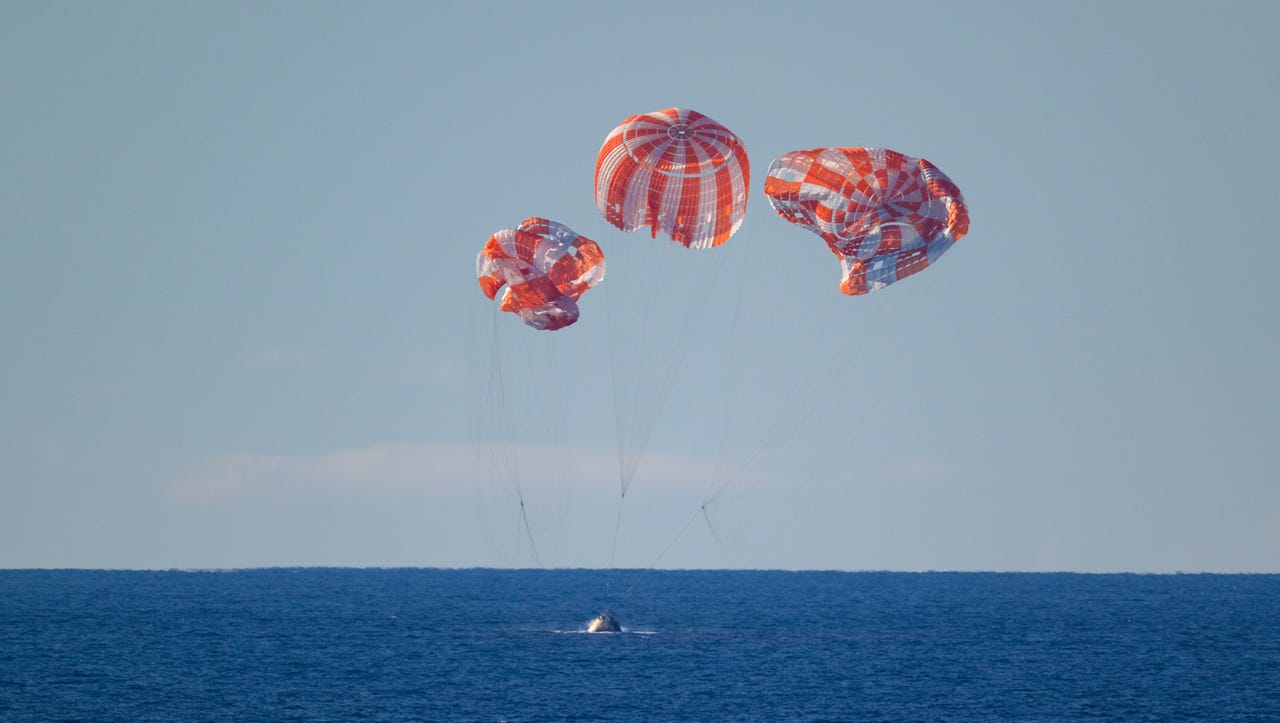
After capturing the attention of a global audience, the crew of Nasa’s Artemis II mission around the Moon have returned to Earth safely, with a splashdown in the Pacific Ocean.
Commander Reid Wiseman, pilot Victor Glover, mission specialist Christina Koch, and Canadian astronaut Jeremy Hansen had become the first astronauts to travel to the Moon in more than half a century as part of a round trip that gave us spectacular images of Earth and the lunar surface. We got more than a few nods to Ryan Gosling’s space film, Project Hail Mary, and even space sim Kerbal Space Program got a boost in players.
The astronauts had traveled 252,756 miles from home at their farthest distance from Earth as part of the nearly 10-day journey. During their mission, Wiseman, Glover, Koch, and Hansen flew 694,481 miles in total. Their lunar flyby took them farther than any humans have ever traveled before, surpassing the previous distance record set by Apollo 13 astronauts in 1970.
Welcome home Reid, Victor, Christina, and Jeremy! 🫶
The Artemis II astronauts have splashed down at 8:07pm ET (0007 UTC April 11), bringing their historic 10-day mission around the Moon to an end. pic.twitter.com/1yjAgHEOYl
— NASA (@NASA) April 11, 2026
After splashing down at 5.07pm PDT Friday off the coast of San Diego, the crew were extracted from the capsule and taken to the USS John P Murtha by helicopter for medical evaluations. They were set to be flown to Nasa’s Johnson Space Center in Houston to be reunited with their families today, April 11.
The flawless return came amid speeds of more than 38,600km/h when the astronaut’s capsule, which the crew named Integrity, hit the upper atmosphere. The heatshield suffered temperatures half as hot as on the surface of the Sun, and due to the extreme heat, the astronauts lost contact with mission control in Houston for six minutes.
Big smiles from Christina and Victor on the deck of the USS John P. Murtha, as they waited to be escorted for their routine post-mission medical checks. pic.twitter.com/3KwZFXTLhI
— NASA (@NASA) April 11, 2026
Speaking to press, Artemis II entry flight director Rick Henfling said there was a lot of anxiety but also a lot of confidence in the room while bringing the Orion crew home. “We all breathed a sigh of relief once the side hatch opened up,” he added. “That’s when we brought the team in. We said a few words to the flight controllers. And then we turned around to the families and waved to the families, and gave them a thumbs up.”
“The Artemis II crew is home. The entry, descent, and landing systems performed as designed and the final test was completed as intended. This moment belongs to the thousands of people across 14 countries who built, tested, and trusted this vehicle. Their work protected four human lives traveling at 25,000 miles per hour and brought them safely back to Earth,” said Nasa Associate Administrator Amit Kshatriya.
“Artemis II proved the vehicle, the teams, the architecture, and the international partnership that will return humanity to the lunar surface. Reid, Victor, Christina, and Jeremy carried the hopes of this world farther than humans have traveled in more than half a century. 53 years ago, humanity left the Moon. This time, we returned to stay. The future is ours to win.”
The next stage of the Artemis II mission is to land humans on the lunar surface and, eventually, build a permanent Moon base.
“Artemis II demonstrated extraordinary skill, courage, and dedication as the crew pushed Orion, SLS (Space Launch System), and human exploration farther than ever before,” commented Nasa Administrator Jared Isaacman.
“As the first astronauts to fly this rocket and spacecraft, the crew accepted significant risk in service of the knowledge gained and the future we are determined to build. Nasa also acknowledges the contributions of the entire Nasa workforce, along with our international partners, whose expertise and commitment were essential to this mission’s success. With Artemis II complete, focus now turns confidently toward assembling Artemis III and preparing to return to the lunar surface, build the base, and never give up the Moon again.”
The Artemis III mission, which will see a new Orion crew test integrated operations with commercially built Moon landers in low Earth orbit, is set for next year. Nasa plans to send Artemis astronauts on increasingly challenging missions to explore more of the Moon, establish an “enduring human presence” on the lunar surface, and lay the groundwork for sending the first astronauts to Mars.
Wesley is Director, News at IGN. Find him on Twitter at @wyp100. You can reach Wesley at wesley_yinpoole@ign.com or confidentially at wyp100@proton.me.