The older I’ve gotten, the more I’ve come to value focused video games. Making a gigantic game that does it all is a technical feat, but these days I’m just as impressed by something compact that nails everything it sets out to do. If you want to see what I mean by that, play The House of Hikmah, which is out now on Steam.
A debut game from Lunacy Studios, the new puzzle-platformer hardly misses a step during its tight runtime. In three hours, it tells an impactful story of grief, gives players a clever set of ever-changing puzzles, delves into the vibrant history of the Islamic Golden Age, and does all that to a fantastic score that any big-budget game would kill to have. It may look small, but The House of Hikmah’s commitment to craft makes it every bit as grand and wondrous as games one hundred times its size.
The House of Hikmah’s story lies at the intersection between grief and culture. Maya is a young girl grappling with the death of her father, Abdullah. Just as she’s unpacking that loss, she arrives at the House of Wisdom, a fantastical video game take on a real intellectual gathering hub located in Baghdad during the Islamic Golden Age. It was home to a who’s who of important historical figures from the Muslim world who ushered in an era of scientific progress. Those figures — names like Ismail al-Jazari and Fatima al-Fihriya — guide Maya through her journey, intersecting with her fictional story in a game that evokes Ubisoft’s Assassin’s Creed series.
Plenty of modern indie games seek to offer a meditation on grief, but The House of Hikmah stands apart from the pack thanks to the way it ties personal loss into a broader cultural context. While there is despair and mourning throughout Maya’s adventure, the game more often feels celebratory in nature. The scholars of yesteryear, dressed in extravagant costumes that make them feel like larger-than-life legends, are immortalized in video game form here. Lunacy Studios urges us to remember these names and marvel at their contributions to fields like astrology and literature. When we hold those we’ve lost in our collective memory, they’re never truly gone. Maya learns that idea in her own quest to mourn her father, discovering all the ways he made an impact on the scholars and transformed the culture he belonged to.
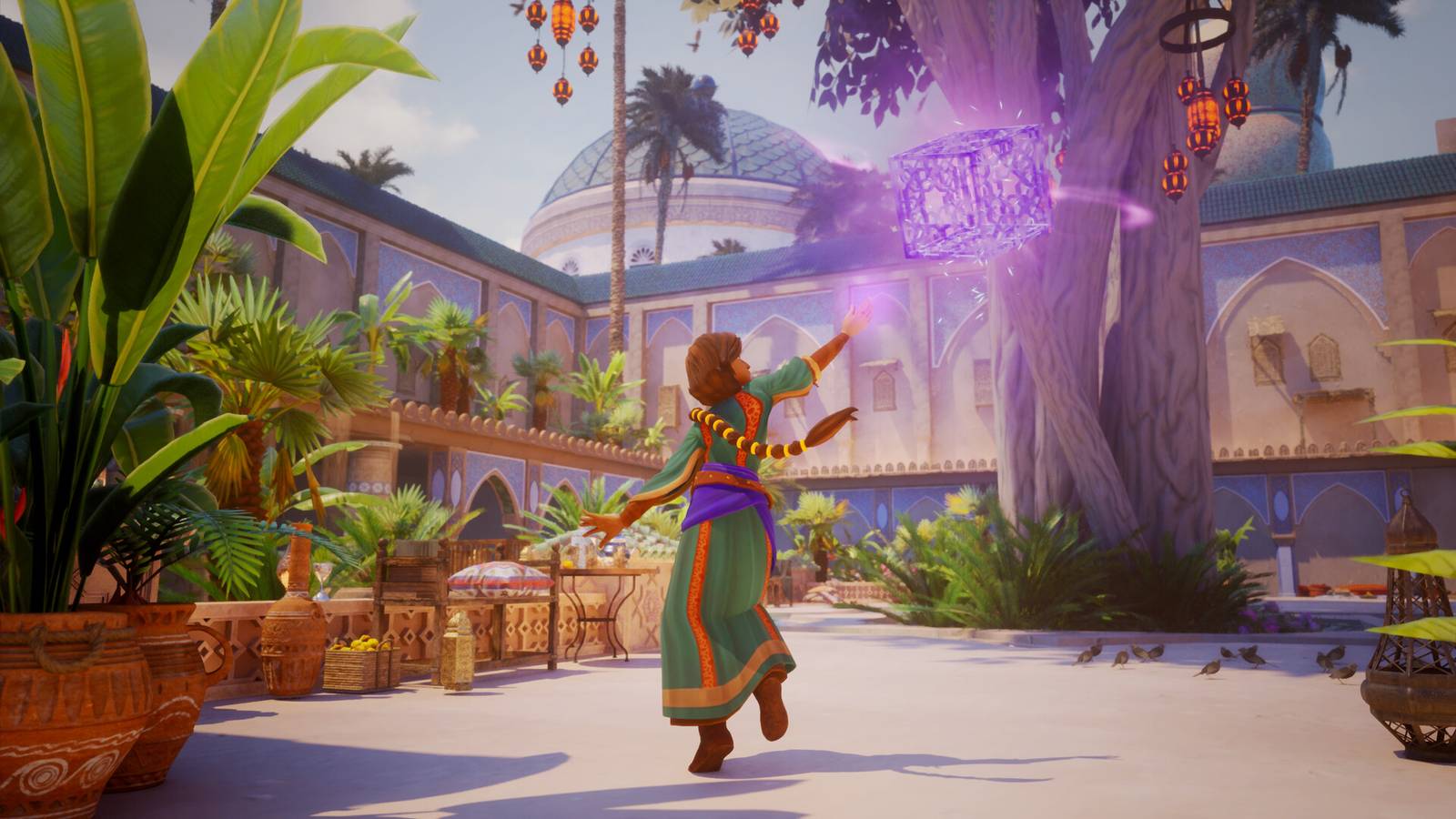
Transformation plays an even larger role in The House of Hikmah, because it’s the basis of the adventure’s strong puzzles. Upon entering the House of Wisdom, Maya obtains a device that her father created called the Key. It has the power to transmute the material properties of items. The story sees her hopping into each scholar’s surreal realm and using the Key to solve puzzles themed around their area of study. Rather than running one idea into the ground, each chapter is a 30-minute exploration of a new twist.
In one area, I learned to turn transparent shards into metal, allowing me to platform around an observatory. Later, I needed to use that material to bounce light beams off pillars. And later still, I had to turn some objects metallic to magnetize them to a spinning gear. That’s just one material. Glass and purple ether play into the equation too, as both redirect light differently and give items a distinct weight. Some light science spills from those few tools, making every puzzle a little physics experiment that’s never too tough, but always satisfying to execute.
It’s a special feat anytime a game can bring you somewhere beyond your imagination and return you to Earth with a desire to dig into history.
While there are some rough edges to a project that dares to punch above its weight class, Lunacy Studios puts a great deal of care into just about everything it touches. Beyond the thoughtful writing and well-designed puzzles, The House of Hikmah sports some unexpectedly high production value that sells its cultural celebration. Full voice acting brings each scholar to life in a way that feels respectful, especially thanks to the fact that you can play the game in Arabic. Sword of the Sea composer Austin Wintory treats the task of producing authentic Middle Eastern music like a badge of honor, creating an evocative score that transports you to another time and place. It’s grounded and magical at once.
The House of Hikmah nails that balance throughout a heartfelt adventure that leaves you a little hungry for more of its clever puzzling. Anytime I found myself pulled deep into the surreal joy of it all, I’d just as soon have to pause to look up a name and read a bit about the real stories of the Islamic Golden Age. It’s a special feat anytime a game can bring you somewhere beyond your imagination and return you to Earth with a desire to dig into history. There are wonders here that stretch beyond borders. Sometimes, a great game can help lead you to them.
The House of Hikmah is out now on Windows PC. The game was reviewed on Windows PC. You can find additional information about Polygon’s ethics policy here.