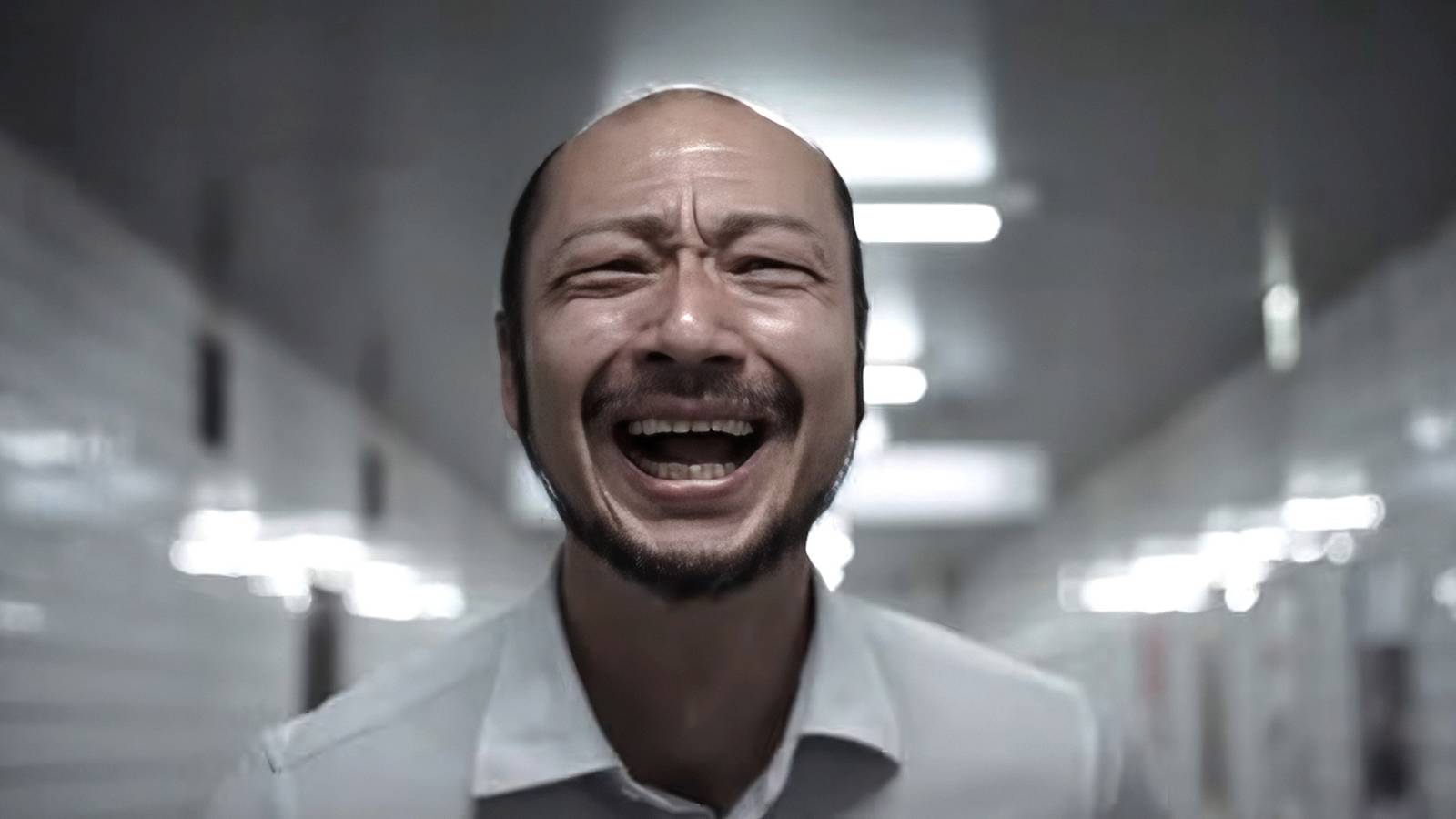
Horror fans don’t need to do any homework before watching the unsettling video-game-to-movie adaptation Exit 8. The film version is self-contained and devastatingly simple. An unnamed commuter (Kazunari Ninomiya, identified on the screen as “The Lost Man”) gets stuck in an impossible maze of sterile, brightly lit corridors while trying to leave a train station. His ex-girlfriend has just called to tell him she’s pregnant, and she needs a decision from him about their potential child. The corridor loop he’s caught in, and the horrifying manifestations that plague him, reflect his own indecision, immaturity, and weakness. Exit 8 is an escape-room movie where The Lost Man is really trying to escape his own tortured mental state, and it’s effective, efficient, and unnerving.
Still, comparing the different evolutions of the Exit 8 story is fascinating in its own right. Exit 8 started out as a walking-sim indie game that drops the player in that same physics-defying maze of white corridors, searching for anomalies that will signal the way out. But game designer Kotake Create offers no backstory about who the point-of-view character is, or how or why they ended up in the maze. For the movie, writer-director Genki Kawamura and co-writer Kentaro Hirase had to build a rationale around the experience, and a character whose situation justifies the world literally warping around him.
“[In] video games as a medium, the player and the main character often overlap,” Kawamura tells Polygon. “So they aren’t very good source material for movie adaptations. A very high-level philosophy I kept when adapting this was, instead of a straight adaptation or a translation, I wanted to blur the boundaries between what the movie medium represents, and what the video game medium represents.”
Kawamura feels that games and movies have evolved with different expectations about the “right” way to tell stories, and for whom. He sees those “lines seemingly kind of drawn in the sand” as limiting for both forms of media.
“I go back to a conference talk session I had with Nintendo’s Miyamoto Shigeru,” Kawamura says. “He told me that really great games, it’s obvious that the player is having a lot of fun — but truly great games, the people watching the player and the screen also need to have a lot of fun. I thought, Well, what’s the audience going to go through for my film? At times, I wanted to place the audience into the shoes of the player, but at other times, I placed the audience in the perspective of someone perhaps viewing a Twitch livestream.”
Kawamura wanted the “viewer as player” and “viewer as audience” perspectives to “coexist in the film” not just as a way of reconciling games and movies, but to make viewers aware of how rarely video game adaptations cross those lines.
“This was perhaps a larger, almost bird’s-eye view of what’s happening in the game industry at large,” he says. “Trying to take this phenomenon of people playing games and watching games, and distill it into a single movie experience.”
Before writing the screenplay, Kawamura says, he watched “many, many streams of Exit 8” to see how different players interacted with and interpreted the game. He says the game’s extremely simple design leaves players a lot of room to map their own expectations onto whatever kind of gameplay experience they end up having: “There were as many stories as there were streams online,” he says.
The way different people approached the game made Kawamura think about the “purgatory-like device” of the endless corridors, and how they might reflect individual victims’ mindsets. He also looked at his own experiences commuting in Tokyo, and what an isolating experience it can be, with every member of a packed crowd tuning out of their physical location and paying attention to their phones instead.
“We’re all in this selfish bubble — I think we ignore a lot of [things around us],” he says. “And that small guilt, those small sins that accumulate — if we were to face those [in the way] they manifest in this corridor, this space, I think that would be terrifying. So I looked at Dante’s Divine Comedy, and this idea of Purgatory, where the characters have to face all the little sins they’ve ignored over time. And that was the origin point for inventing the story.”

Kawamura and Hirase also expanded the character and backstory of the Walking Man, a voiceless NPC in the game who gets his own unnerving story arc in the film.
“What I found most fascinating is, in my world that I exist in, I’m the main character, and others might appear as NPCs,” Kawamura tells Polygon. “But the opposite is also true — in others’ lives, I’m an NPC. That’s a very game-like way of thinking about and looking at the lens. So if the Walking Man was the main character, what kind of story would that entail? That’s something I thought about when writing the screenplay.”
In addition, Kawamura, who is also an internationally bestselling author, wrote an upcoming novelization of the movie that elaborates even more on the characters’ backgrounds. And as an anime producer who’s worked on some of the biggest standalone film titles of the last decade — Your Name, Suzume, Belle, Bubble, Mirai, Weathering With You, The Boy and the Beast, and more — he’s also been involved in adaptation projects like the the live-action J.J. Abrams version of Your Name. For him, adaptations from one medium to another are “both a challenge and an opportunity.”

“I look at my background in the Japanese animation space, which is part of my identity as a creator, and I think that’s what helped inform a lot of what I did in Exit 8,” he says. “Japanese animation, I feel, is really, really good at manipulating time and exploring what happens within the human mind, and visualizing it, turning it into visual expression. You look at all the greats in the Japanese animation space — Miyazaki Hayao, Oshii Mamoru, Kon Satoshi — they’ve all done this so well. It was a great experience, looking at what they’ve done and translating what Exit 8 is doing into a live-action adaptation.”
With that in mind, Polygon asked if there were any other video games he’s dying to adapt to film. Kawamura laughed at the question.
“I would’ve loved to have done Backrooms,” he says. “But someone else already had that idea. So I’m looking forward to how they translate that into a movie.”
Exit 8 is in theaters now.