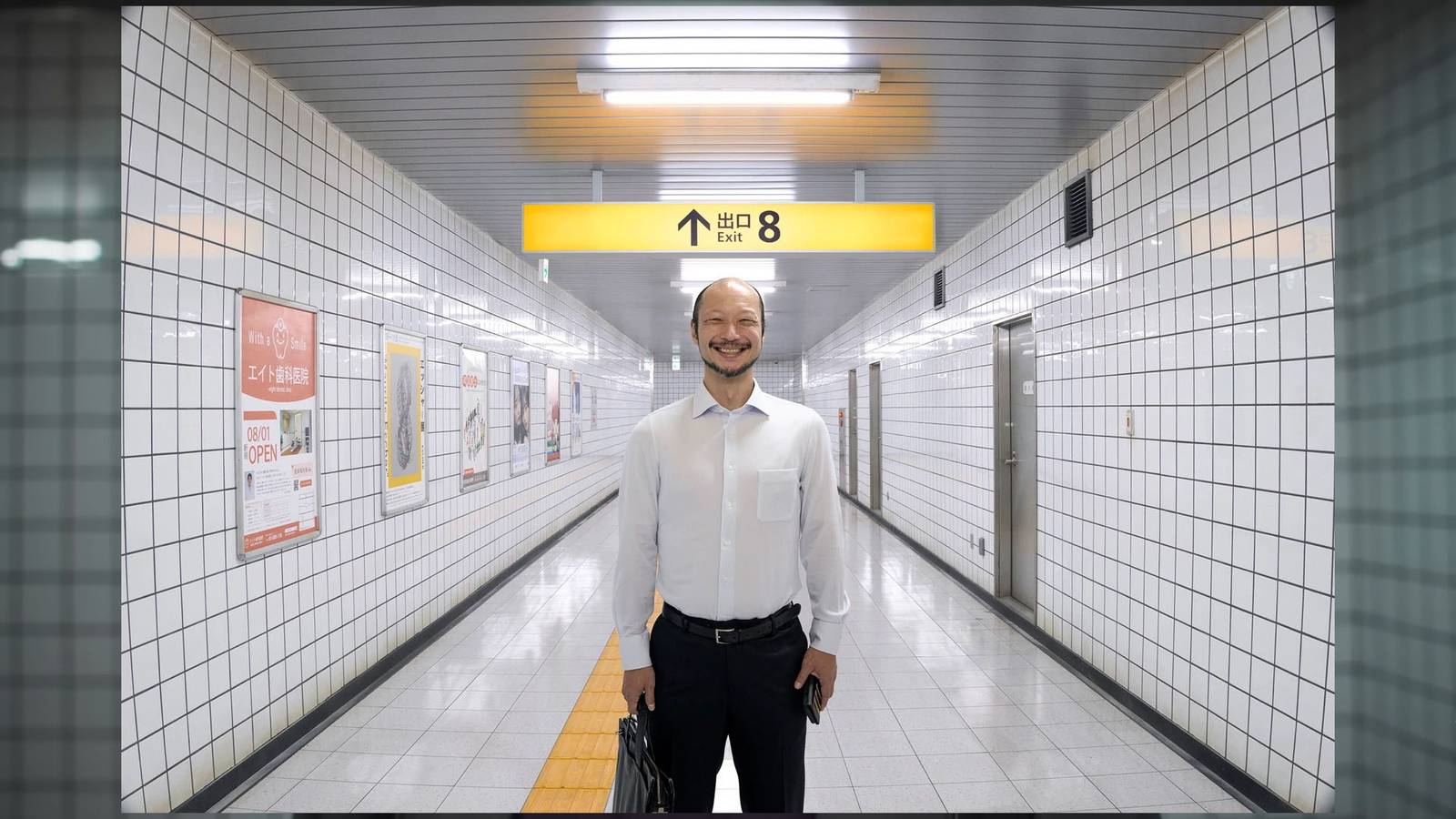
A young Japanese man trapped in a brightly lit, surreal hallway desperately counts the number of doors, vents, and lockers. He obsessively checks the words written on the poster ads lining the walls, as he looks for any kind of visual anomaly. Once he’s certain nothing is amiss, he heads toward the end of the corridor, but is suddenly startled by the sound of a crying baby, a noise he realizes is coming from one of the lockers. He breaks into a sprint, hoping to finally find Exit 8 and escape this hellish corridor.
Produced by Toho and directed by Japanese author and anime producer Genki Kawamura, Exit 8 tells the story of an unnamed “Lost Man” (Kazunari Ninomiya) who discovers he’s trapped in an infinite subway corridor. In a place that constantly defies logic, The Lost Man must deal with his emotional uncertainties, or he’ll never escape.
That simple premise is surprisingly effective. Based on the 2023 indie video game of the same name, Kawamura’s movie proves the director understands both his source material and the power of its metaphor. Exit 8 is a rich symbolic experience that offers an alternative path forward for future video-game adaptations.
The video game Exit 8 falls into the walking-simulator genre — games where walking through an environment is the main activity, sometimes with puzzles to solve, but rarely with any traditional combat or action. In Exit 8, the player is trapped in an endless corridor. To escape, you follow a simple rule: If you notice any abnormalities, turn around and head in the opposite direction. Completing the game involves analyzing the corridor and correctly choosing which way to go eight times in a row. If you ignore or miss an abnormality, you lose all your progress.
Exit 8 doesn’t follow the trendy convention of designing walking simulators around jump scares, like Bloober Team’s Layers of Fear. There’s no intricate lore, no direct allusions to well-established horror tropes like eldritch creatures. Even so, the simple existence of the corridor and the absence of any logic tied to what happens inside of it (sort of like the Oldest House in Remedy’s Control) make Exit 8 feel distinctly modern in its sense of dread. Those elements also make it one of my favorite horror games in recent memory. So when I found out that Exit 8 was now a movie, I was intrigued but skeptical. Could this simple-yet-terrifying experience translate into another medium? The answer turned out to be yes, but not in the way I expected.
Kawamura makes an unconventional decision in his adaptation of Exit 8. He uses key elements of the original work, but ties them to a brand-new character. Unlike the game with its anonymous protagonist, we know a lot about the person who’s trapped in this corridor. Ninomiya’s character is a young man with a part-time job. Just before the corridor trap closes around him, his ex calls to tell him she’s pregnant, and in the hospital for tests. She needs to know how he feels about possibly becoming a father.
This information completely redefines the Exit 8 experience. Kawamura gives the story’s endless loop a new meaning by turning it into a metaphor for the main character’s feelings. Throughout the movie, Ninomiya’s unnamed protagonist argues with himself about what he wants to do with his ex’s information. Until he decides, he’s stuck in limbo.
While the corridor becomes an extension of the main character, it’s also a broader metaphor for the cycles of life and masculinity. In the movie, three generations of men are connected: the main character, an older office worker, and a little boy. We meet the other two as the white-collar worker tries to find the exit so he and the boy can leave. However, he’s torn between the desire to save himself and the urge to be a good person and help the boy escape, too. The juxtaposition of these male characters inside the infinite corridor reinforces the idea that men are constantly running from their decisions and abandoning the people who depend on them.
Kawamura’s choice to begin the movie with his protagonist listening to Maurice Ravel’s “Bolero” — a 15-minute orchestral composition that repeats its melody with various instruments — reinforces the same themes. Only through the physical and nightmarish experience of being trapped in this loop does the protagonist finally begin to question his own behavior. This modern — and less diabolical — version of Hell in Dante Alighieri’s Inferno guides the lost man through a personal journey to defy the cycle he was born into.

Exit 8 the movie isn’t necessarily as scary as Exit 8 the game, but the ways Kawamura uses that creepy white corridor to tell a much more personal story make this a worthy adaptation. It’s fascinating to see how the game’s digital corridors take material form in the movie, but with a completely different meaning. Instead of simply being an eerie place where bizarre events take place, they become the manifestation of a visceral uncertainty so many of us deal with in our own lives.
By giving a face and a history to the characters inside the corridor, Kawamura creates a completely new experience, and that’s a good thing. There will always be a market for faithful, bit-by-bit adaptations of our favorite video games. But the individual, personal symbolic universes many games create for each player are commonly ignored. With Exit 8, the director clears a fruitful path others can follow when adapting video games: a path that respects the original material, but accepts that there’s room for different and new stories to be told.
Exit 8 opens in U.S. theaters on April 10.