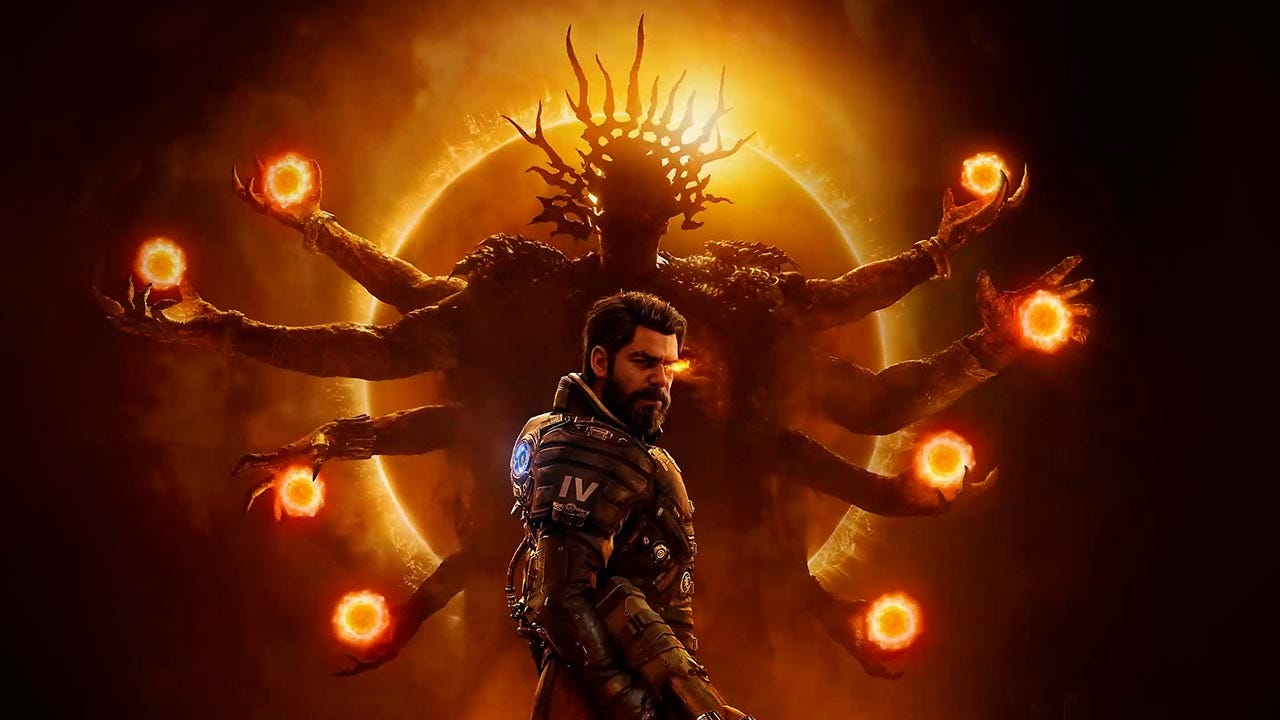
Sometimes, against our better judgment, we do the same thing over and over again hoping for a different outcome. Developer Housemarque’s new third-person bullet-hell shooter Saros explores this idea in many ways – the roguelite level structure, the repeated combat encounters, and the internal conflicts of its main character, Arjun. It has a familiar gameplay foundation to its predecessor Returnal, too, with fluid gunplay and deft movement. But in trying to be more thematically ambitious, Saros opens itself up to pitfalls Returnal didn’t have to manage, leaving some of its more interesting threads unsatisfyingly hanging. Still, its tough-as-nails combat is worth getting good for, even when its repetition can wear you down.
Arjun Devraj is an expeditioner for the space corp Soltari; he sports the voice and likeness of actor Rahul Kohli, who absolutely nails the leading role. His crew is sent out to investigate the disappearance of previous expeditions on Carcosa, a planet riddled with biomechanical imagery and the gothic architecture of a lost alien civilization; the science-fantasy and Giger influence is definitely used effectively here. It’s also reminiscent of the modern Doom games, especially when its chaotic combat encounters and pounding soundtrack evoke a similar feeling.
You quickly realize that something is extremely off, with each solar eclipse turning the planet into a hellscape and inducing a deep psychosis that chips away at everyone’s well-being as tensions grow increasingly hostile. There are parallels to works like Heart of Darkness or Apocalypse Now here, but Saros is more of an adaptation of the 19th century anthology “The King In Yellow” by Robert Chambers. It pulls names and themes directly from the book itself while brushing up against a little cosmic horror. You see Arjun battling with his own sanity and past decisions as you get further and have to ponder: What is Soltari’s real purpose? Does that matter? Why does Arjun keep respawning as few even bat an eye? Is any of this real? Those are all interesting questions as you unpack what Saros is really about.
You do so primarily by blasting through multiple run-based levels that make up Carcosa. The more you familiarize yourself with the unrelenting attack patterns of enemies and learn how to be effectively aggressive with weapons you vibe with, the closer you get to a flow state that speedy shooters like this uniquely tap into. It’s strongly rooted in Returnal’s design philosophies with a few edges sanded off, and while I don’t think Saros is necessarily an evolution, I came away with a sated appetite for Housemarque’s house style.
Carcosa’s various biomes are broken up into distinct levels, which themselves must be completed in a single run to make progress. It’s a different way of packaging a similar idea; levels shift ever so slightly with each run, pulling from a defined set of rooms to generate the path forward. Some rooms emphasize platforming challenges, most throw hordes of biomechanical amalgamations at you, and some are a tough mix of both. Runs do begin to blend together as the cadence doesn’t really change that much since the parameters are fairly tight. But in a game like this, death is part of the process, and each failed run is a training ground for what you ultimately need to do – get through the level as healthy as possible and defeat its boss in one fell swoop.
This largely works because, like it has done historically, Housemarque makes damn good shooters – from 2D and top-down shmups such as Resogun and Nex Machina to the third-person bullet-hell of Returnal. Speed and agility are priorities and that’s balanced with a generous tracking system for aiming, which makes Saros play a little closer to an arcade shooter. I often relied on the Onslaught Rifle that disables auto-aim altogether for powerful shots, or the Smart Rifle that homes in on targets to let me focus on mobility. Most guns come with a satisfying impact, including pistols that remain relevant throughout and the late-game ripsaws that tear through enemies with damage-over-time, all of which come with different perks and in several variations that drop randomly during runs. Saros makes brilliant use of the DualSense controller’s haptic feedback here, mapping its alternate fire modes to a half-trigger pull that you physically feel and the wind-up of your Power ability to a full-trigger pull, both of which are crucial to execute at a moment’s notice.
Firepower is only half the battle because the most challenging part of Saros is reacting to the colorful beams that hound you on the battlefield. Enemies fire off a rapid mix of blue shots that can be absorbed to fuel your shield and Power ability, red shots that can be parried but not blocked, and yellow shots that build Corruption to limit your max health (but empower certain weapons). Knowing when to evade and when to take those hits head-on is something you’ll constantly have to process, and learn to love. Where fighting through hordes of aliens in combat arenas is about managing the chaos of everything they throw at you, boss fights are more about attention to detail, where swift visual and audio cues tip you off to what’s coming, asking you to be quick enough to position yourself and react while still finding windows of opportunity to get your own shots in. This dynamic tapped into a little bit of my rhythm game skills and it’s this test of your reflexes that I enjoyed most; even in moments of frustration, I knew coming out the other end of it would be a moment of triumph.
Saros eases the friction of Returnal a bit by putting a bigger focus on permanent resources and upgrades (even giving you a second-chance revive early on). Back at the home base hub area, you’ll work through a skill tree that improves your health, shield and power potency, and rate of resource gathering. Certain branches can boost weapon leveling to help pick up better versions in runs or make your clutch ultimate ability stronger. But progress isn’t necessarily about deepening your skillset or fundamentally changing your playstyle, rather it’s about making its challenges a little more manageable for future runs and, of course, playing smarter. Nodes in the skill tree are incremental upgrades that are important to obtain because things do get very difficult.
This is why Saros can get pretty monotonous at times. Instead of challenging you to think creatively about combat, more weight is put on your ability to survive in a war of attrition. I respect that approach, but when you have to spend 20 to 30 minutes going through the motions in a level just to get another shot at the boss, the repetition begins to settle in. I suppose it comes with the territory for a roguelite shooter of this style, where buildcrafting isn’t really a thing outside of the Artifacts that temporarily boost your stats (and come with debuffs to consider) and hopefully plucking out your preferred weapons/powers with a good set of perks. It’s an approach that has its merits, demanding that you stay locked in during a run, but that doesn’t stop it from feeling tedious in spots.
As a PlayStation 5 exclusive, Saros seems like it’s trying to align itself more closely with Sony’s other “prestige” single-player games by having a more deliberate, high-concept story. Themes of trying to break harmful cycles, coming to terms with grave mistakes, and even struggles with sexual identity work their way into what initially seemed like something primarily inspired by Hollywood sci-fi. I commend that direction because these are intriguing threads to pull on, but the ways the storytelling comes up short really stick out when there’s a bigger emphasis on it this time around. Saros gets halfway there, but unfortunately leaves many of its stronger plotlines underdeveloped.
Arjun is a compelling lead because while he’s deadset on chasing someone important to him on Carcosa, something deeper continually brews inside him. His stubbornness manifests in various ways as he simultaneously tries to make sense of the loop he’s stuck in and the vision that haunt him as he wakes up for another run. There are moments when Saros built toward revelations that felt like breakthroughs in the story, which had me engaged – but sometimes those moments would be tee’d up without the follow-through required for them to fully payoff. Flawed, even irredeemable characters can be really interesting, and feeling conflicted about these kinds of stories is a fascinating mental exercise to work through, but you need a deft hand to truly pull that off.
Most supporting characters have arcs that boil down to their descent into madness told in voice notes. And aside from a select few crewmates back at base (and a bossy Soltari computer that has a bit of an identity crisis), there isn’t much added depth. Brief conversations in the hub area with the crew feel oddly stilted, but at least serve to feed into the unnerving setting. However, Saros does have some of the strongest use of readable data logs I’ve seen in a while. Beyond just being flavor text, there’s some great writing that provides insights in the form of Soltari reports, employee data, or diary-like entries which create a kind of thematic texture that’s genuinely effective; and I wish some of this found its way into the main story.
It doesn’t help that the storytelling is so abstracted that it obscures your understanding of what is actually happening. I’m not asking for its message to be spoonfed to me or its twisting sequence of events to be laid out in broad daylight, but I do expect a story to create throughlines that lead to something we can define with only the pieces we’re given. Some of my favorite stories in games leave things up to interpretation, because there’s real power in connecting the threads for yourself, but they still had to lay the groundwork to let us piece it together and form our own perspectives. Saros has flashes of this that’ll provoke interesting spoiler discussions, but I get the sense that it relied a little too heavily on its literary inspiration to fill the gaps.
Returnal was impactful because it solely focused on Selene and her time loop fighting through Atropos; it used that format to reflect her personal struggles that were subtle in the early hours then gave you the means to paint a clearer picture the deeper you got. Roguelite as a metaphor worked so well there, and its parallels hit hard when you reached a point where it all started falling into place. Saros bites off more than it can chew, which I can admire, but the actual execution struggles to send the message it thinks it’s sending.