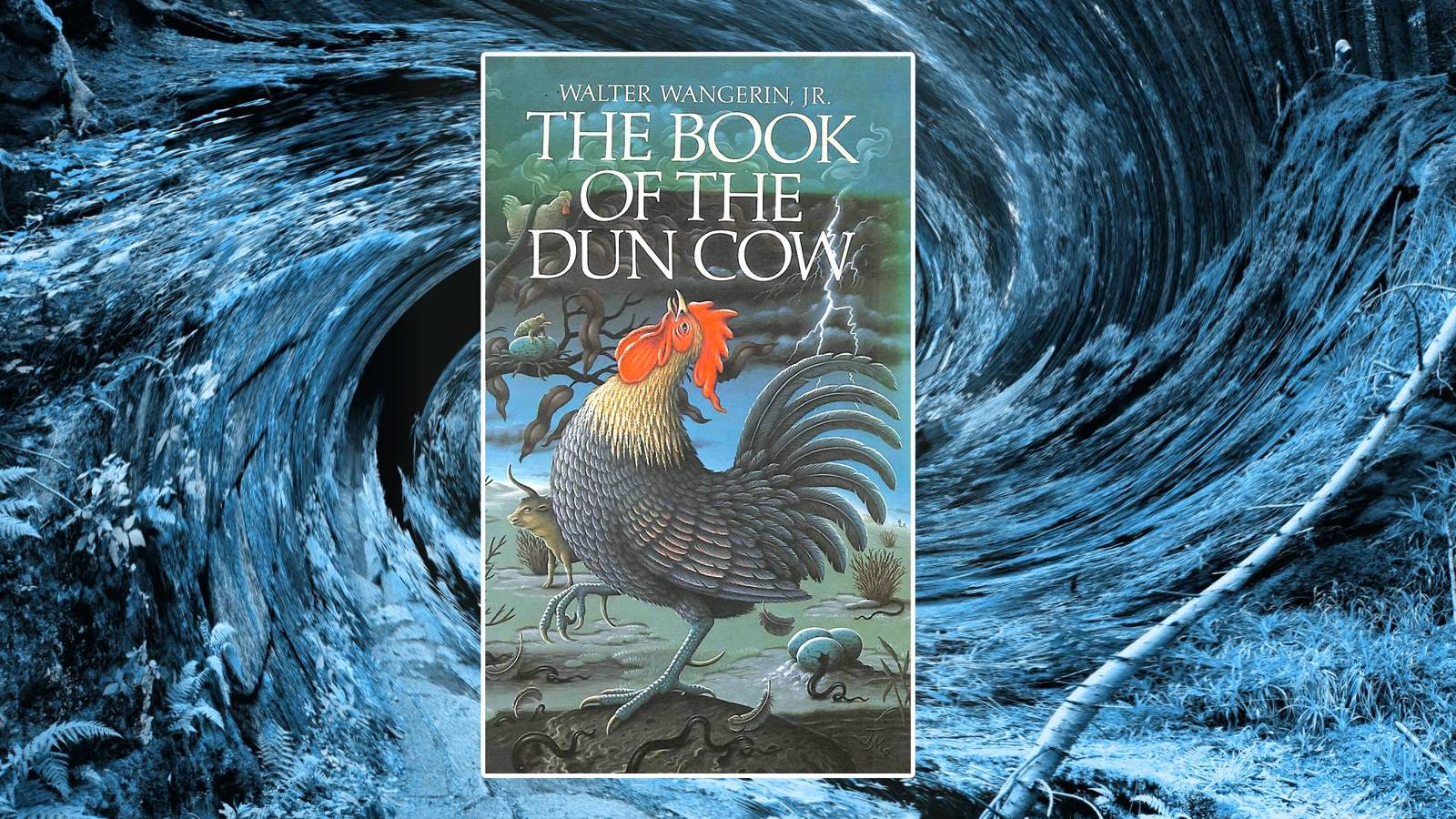
Ever see a piece of news online and feel like it was aimed specifically at you? That’s how I felt when Goodman Pictures announced the formation of a new animation company, Underneath the Umbrella Productions, which plans to develop a movie version of Walter Wangerin’s fantasy novel The Book of the Dun Cow. The L.A. Times once said this book “belongs on the shelf with Animal Farm, Watership Down and The Lord of the Rings,” but it’s largely forgotten today. I doubt many other modern fantasy readers perked up at the adaptation news.
But I’ve spent most of my life wondering what Wangerin’s cataclysmically dark, weirdly funny book would look like as a movie. Now, there’s a slim chance that we could finally find out. Better yet, there’s a chance that the news might prompt a few more people to read one of my all-time favorite fantasy books.
As a teenager, I was obsessed with The Book of the Dun Cow, a National Book Award winner that never felt like it was nationally known. I grew up on talking-animal fantasies — C.S. Lewis’ Narnia novels, Roald Dahl’s Fantastic Mr. Fox, The Cricket in Times Square, Charlotte’s Web, The Jungle Book, and a hundred more — but once I hit a certain age, they felt like kids’ stuff. In my mind, Book of the Dun Cow was the bridge between those childhood favorites and a richer, more complicated, far more dangerous adult world. Wangerin draws on the familiar tropes of childhood fiction, but brings them to bear on a much grimmer, knottier, stranger story — one so close to Lovecraftian cosmic horror that to a teenager, at least, it felt daringly unsafe.
Book of the Dun Cow takes place in a world before, after, or just completely without humankind. Unlike the talking animals of, say, the Redwall or Mouse Guard series, the ones in this book don’t wear clothes, walk around on their hind legs, or otherwise come across as humanoid. That certainly leaves questions about where the very few constructed objects in this world came from, but Wangerin glosses over that, turning this book into more of a fable than a watertight exercise in internally consistent world-building.
The animals of Book of the Dun Cow live on the surface of the world, unaware that there’s a monstrous, ancient threat lurking in the center of the earth, and that their innate innocence and purity keep it sealed below. (They’re essentially a living ’70s version of KPop Demon Hunters’ Honmoon.) That evil, aptly named Wyrm, is a monstrous serpent that longs to escape its world-prison, and deeply resents that its unaware jailers are simple, lowly animals. He fantasizes about tearing his way free through the Earth’s mantle and running riot through the cosmos: “Oh, he would swallow the moon in a gulp,” Wangerin writes. “He would bloody the sun. And he would roar almighty challenges to the Lord God Himself. He would spew chaos among the stars.” So Wyrm embarks on a plot to destroy animal society and poison the world.
Wangerin, a Lutheran pastor, professor, and radio host, draws his character names and some of his broad tone from Chaucer’s Canterbury Tales, and his title from the oldest known Irish manuscript. His protagonist, Chanticleer the Rooster, the lord of animals in his land, is ridiculously vain, arrogant, short-tempered, and prone to self-pity. He’s also kind, protective, valiant, and devoted to the animals of his domain. When Wyrm brings a monstrous horror into the world to kill them all, Chanticleer and his people stand up to it, in a horrifically Pyrrhic war for survival.

Book of the Dun Cow’s Christian overtones are unmissable for an adult reader, as they are in Lewis’ Narnia books. While the animals pray to God and sing his praises, though, he’s a distant presence in this cosmos, and often seemingly helpless to intervene in the universe he created. God locked Wyrm in the Earth and set the animals over him, but the only help he can offer them is to indirectly, through oblique messengers, point them toward sacrifice and suffering in the cause of good. Wangerin’s theology, built around the doubt and despair some people may feel while struggling to maintain faith, is thornier than Lewis’. Wangerin’s villain is far more terrifying and powerful, and his heroes are far more flawed, fragile, and complicated.
They’re also much funnier. Chanticleer and his people go through overwhelming horrors in Book of the Dun Cow, but they have ridiculously strong, endearingly flawed personalities that manifest in all sorts of odd little quirks and lovely little bits of comic business. Mundo Cani Dog, the canine heart of this story, has a grandiose obsession with his own hideousness. John Wesley Weasel, a scrappy, belligerent little warrior, talks about himself in the third person, with an endless overdose of exclamation points. Wangerin devotes entire chapters to the bubbly, oblivious idiocy of the entire turkey species. And Chanticleer, above all, is a tragicomic figure who struggles to protect and save even the smallest and lowliest of his flock while he’s barely able to master his own self-absorption.
The New York Times dubbed Book of the Dun Cow the best children’s book of 1978, but it’s bizarre that their editors thought this novel was aimed at children. Talking animals aside, it’s an overwhelmingly bloody, caustic horror story, and one that presents a much more complex vision of the battle between good and evil than most children’s books can manage. Frankly, it’s impossible to imagine it making it to the screen with either its ruthless darkness or its many quirks intact — it’s a deeply idiosyncratic book, an absolutely unique experience, and one that would be hard to capture on the screen. But I’m glad someone wants to try.

That doesn’t mean I actually think we’ll ever see a film version of this story. Underneath the Umbrella Productions announced two “beloved” IPs it’s developing — the newspaper comic strips B.C. and The Wizard of ID. Put those next to Book of the Dun Cow, and you have an incredibly odd starting lineup. B.C. and The Wizard of ID, both created by late cartoonist Johnny Hart, are gag-a-day strips that have been running since 1958 and 1964, respectively. The former is about a bunch of cavemen (and women, who until 2019 were simply known as “Fat Broad” and “Cute Chick”); the latter, about life in the castle of a despot king. They’re both radically unlike Book of the Dun Cow in almost every way — except that Hart was a Christian who frequently published strips about his prehistoric humans’ relationship to Jesus.
That makes me suspect Under the Umbrella wants to be in the faith-based movie business, which is going to make it harder to find producers for a Book of the Dun Cow movie, in an environment where funding an independent fantasy movie based on a generally forgotten novel would already be prohibitively difficult. Animation is expensive and time-consuming, and a new company entering that arena is going to face a lot of barriers. Even well-established companies with huge piles of money and a fully formed production pipeline struggle to complete animated projects. (Remember the Redwall TV series from Over the Garden Wall’s Patrick McHale Netflix announced four years ago? It was reportedly just canceled this week.)
Even if this movie is ever completed, chances are good that it’s going to simplify the story, modernize the humor, lighten up the horror, and actually aim the story at kids. There’s never been another book like Book of the Dun Cow. (Wangerin’s best-forgotten Dun Cow sequels included.) So rather than waiting for a movie that might never manifest, why not take this news as an excuse to read one of the strangest, saddest, most thrilling talking-animal fantasies ever written?
The Book of the Dun Cow is available at Amazon, Bookshop.org, Barnes & Noble, and other digital and physical retailers.
If you buy something from a Polygon link, Valnet Inc. may earn a commission. See our ethics statement.