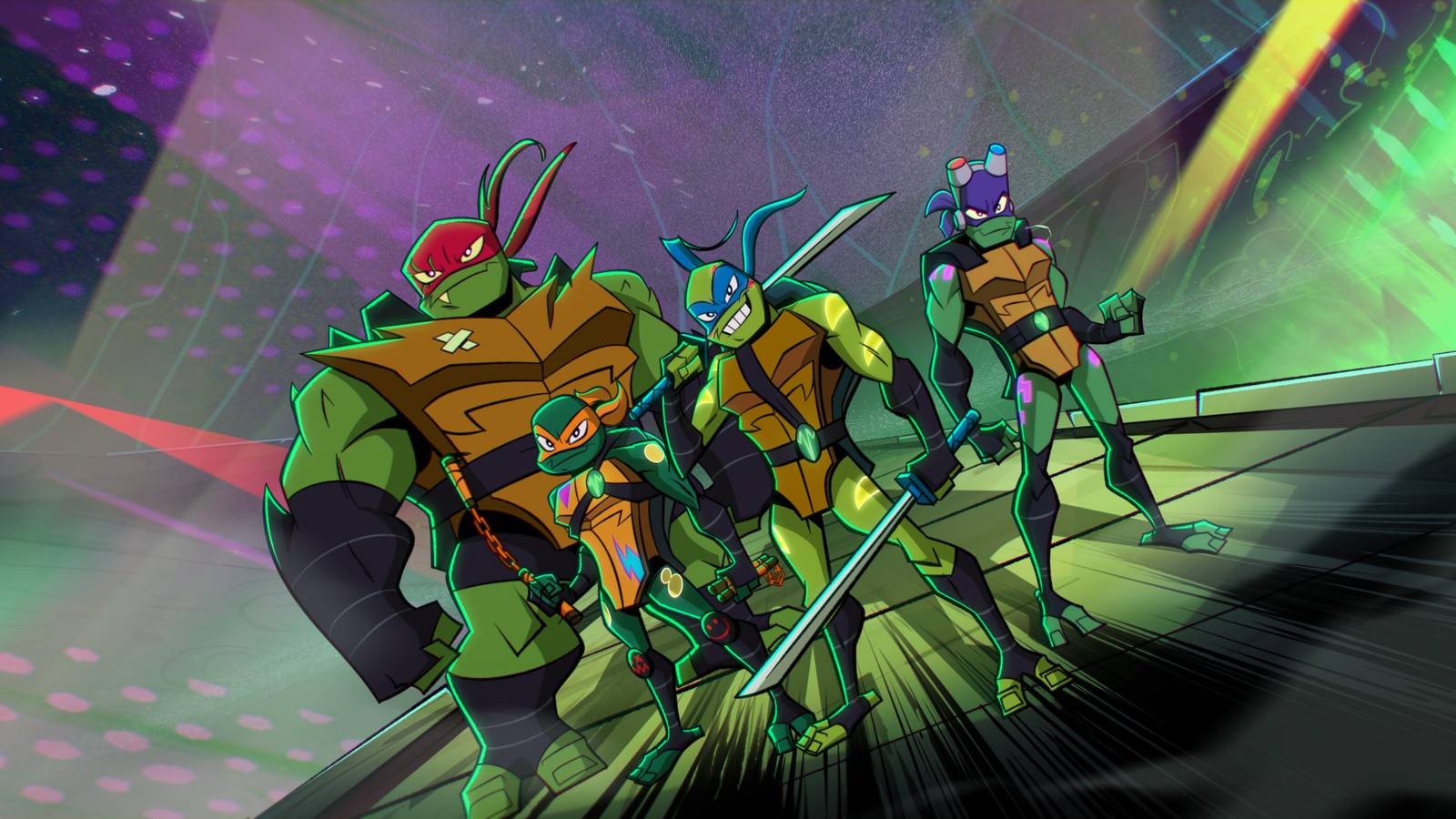
This week, one of the most divisive iterations of the Teenage Mutant Ninja Turtles is making a a comeback when a new book by IDW Publishing, The Art of Rise of the Teenage Mutant Ninja Turtles, hits Amazon and store shelves. Written by series superfan turned author Colin Stein, the over 300-page book showcases the artwork and development of the series that lasted from 2018 to 2020, as well as the 2022 Netflix movie that concluded it. Perhaps most excitingly, parts of the book are dedicated to abandoned concepts for the short-lived cartoon, including lost episode summaries and plans for two extra mutant turtles which were only ever hinted at in the original run.
Created by animation veterans Andy Suriano and Ant Ward, Rise of the Teenage Mutant Ninja Turtles premiered on Nickelodeon in July 2018. After Nickelodeon concluded the 2012 Teenage Mutant Ninja Turtles cartoon, the company, which acquired the Turtles in 2009, aimed to do something different with their second series. While Nickelodeon’s 2012 series was widely praised for reimagining much of the Turtle lore from previous iterations, Rise of the Teenage Mutant Ninja Turtles made some bold changes to the characters. The result was a split in the fandom. Many old-school fans disliked the series, while those who did enjoy Rise became deeply dedicated to it.
Among the show’s most fundamental changes was that Leonardo was no longer the leader. Instead, a somewhat more dim-witted Raphael took charge simply because he was the biggest. (In Rise, Raph is a snapping turtle while his brothers are various other, smaller species.) Leonardo, meanwhile, became a snarky, comedic character. The plan was for Leonardo to grow into his traditional leadership role, but the series’ short run prevented this from happening, though Leo’s transformation did occur in the more widely accepted Netflix movie.
The series also changed the central villain, Shredder, to a new character named Baron Draxum, a member of an ancient race of mutant-like creatures known as Yōkai. Mutants, however, was the name given to the animal/human hybrids created by Draxum.
With this change also came an alteration to the origin of the four Ninja Turtles and their two unrealized siblings. Like in several other iterations of the Turtles, the Master Splinter of Rise began his life as a human named Hamato Yoshi, though in this reality he was a martial arts movie star with the stage name Lou Jitsu. Looking to create an army of mutants to help protect the Yōkai, Draxum kidnapped Lou Jitsu and used his DNA to mutate baby turtles, which had been placed into small pods in a gigantic mutation chamber. However, an episode late in season 1 showed six pods attached to Draxum’s device, not four.

An interview with Suriano in The Art of Rise of the Teenage Mutant Ninja Turtles even confirms that six baby turtles were present during the mutation event, but only four of them were rescued by Splinter/Lou Jitsu. “There was indeed a no-nonsense eldest brother out there as well that would shake up the family dynamics further, especially for Raph and Leo,” Suriano reveals in the book.
Suriano’s comments and that yellow oval are all we really know about the older brother, but a little bit more is known about their sister.
Another new villain in Rise of the Teenage Mutant Ninja Turtles is Big Mama, a Yōkai spider creature. In one of the episodes featuring this character, she has a masked assistant who doesn’t speak. In the book, Suriano explained, “The payoff of Big Mama’s assistant would reveal that she would indeed be another turtle sibling, and we would get to see what being raised by a spider mama would do to a teenaged mutant vs. the warmth of Splinter.”

This character would not be seen again in the series or the Netflix film, but she did have a very brief cameo in 2024 when IDW comics celebrated the 40th anniversary of the Teenage Mutant Ninja Turtles franchise. In the Teenage Mutant Ninja Turtles 40th Anniversary Comics Celebration, many of the different iterations of the TMNT were revisited with short stories set in their respective continuities. For the Rise story, Leonardo is sent travelling through time by a mystic-powered Michelangelo who is still fine-tuning his powers. This causes Leo to be briefly sent to a variety of different times. In one of those erroneous destinations we see Big Mama’s assistant removing her mask to reveal a turtle underneath.

Beyond this one comic-book panel, not much is known about the sister, but we do know who she isn’t. In 2022, story artist JJ Conway wrote on Twitter, “As I recall, the plan was for their sister (Big Mama’s assistant) to be an original character, not an adaptation of an existing character (so not Venus or Jennika).” Venus was the long-lost sister from the 1997 live-action series Ninja Turtles: The Next Mutation (a series even more maligned than Rise), and Jennika is the Foot Clan member turned mutant turtle in IDW’s still ongoing comic book series.
Instead, her potential identity was revealed in another tweet from someone else staffed on the show. In 2023, Rise writer Ron Corcillo tweeted, “We were going to name her after a female artist, possibly Frida Kahlo.”
As The Art of Rise of the Teenage Mutant Ninja Turtles author Colin Stein tells Polygon, “Frida has never been confirmed as the official name for the character, but the Rise fandom embraced it and that became her name online.” She’s even inspired a good amount of fan art.
Beyond those very brief appearances and comments from people involved with Rise of the Teenage Mutant Ninja Turtles, not much is known about those two unrealized siblings, but things may not stay that way. In 2024, Cartoon Base asked Suriano about the possibility of a comic book continuation of Rise of the Teenage Mutant Ninja Turtles. Suriano replied, “It’s being discussed — so readers should let IDW Publishing know!” So while the two additional siblings of the Turtles were “long lost” in the original run of the series, they may indeed be found eventually.