In the late 15th century, a man named Thomas Malory, whose identity is still debated by scholars, wrote Le Morte d’Arthur, a compilation of legends, chivalric poems, and folklore related to King Arthur and the Knights of the Round Table. Five centuries later, British director John Boorman (Deliverance, Hope and Glory) turned that source material into a movie that is still considered a milestone in the history of fantasy cinema (even if it’s hard to classify as “fantasy”). Excalibur is bold, ambitious, and above all, uncompromising. Forty-five years later, it stands as a testament to a director’s audacity to propose his artistic vision to audiences without filters.
As some critics pointed out over the years, Boorman’s epic can throw off spectators with its disjointed flow and weird dialogue. The characters have also been criticized for being inconsistent due to the frequent time jumps in the story, while the plot has been accused of lacking dramatic intensity. However, this is all a result of design rather than incompetence. Excalibur feels more like seeing a stage play than a movie. Every scene is a set piece, a tableau where a fragment of the fairy Arthurian world comes to life. The movie isn’t trying to show a story in the traditional sense. Rather, it attempts something that few works of visual media succeeded at: telling a myth.
Like Homer’s Iliad and Odyssey, Malory’s Le Morte d’Arthur is collected and collated from renditions of a corpus of myths that developed over centuries (but while Homer’s sources are believed to be mostly oral, Malory could rely on an extensive written tradition). These attempts to turn myths into narratives helped these ancient stories last to this day; but myths, whether they come from the Mycenaean civilization or from the European Early Middle Ages, express themselves in ways that are fundamentally different from what we consider “modern” narrative. So, any attempt to transpose myths in other forms, such as cinema, has to maintain and respect that difference, and that’s something that Boorman and his co-writer Rospo Pallenberg understand well.
Excalibur looks and sounds like a myth. In fact, it’s ripe with references to mythographic works. In the movie, when King Arthur falls ill, the land withers and weeps. This image comes from the figure of the Fisher King in Arthurian myth, but the connection between the king and his land is a much older concept, one that is thoroughly explored in James George Frazer’s seminal study of comparative mythology and religion, The Golden Bough, which is often credited for inspiring Excalibur way more than Le Morte d’Arthur. As Boorman said in an interview with journalist Harlan Kennedy in 1981, “The film has to do with mythical truth, not historical truth.” Talking about the movie’s setting, he added: “What I’m doing is setting it in a world, a period, of the imagination. I’m trying to suggest a kind of Middle-earth, in Tolkien terms.”
The reference is significant: according to Boorman’s memoirs Adventures of a Suburban Boy, Excalibur began as an adaptation of The Lord of the Rings, pitched by United Artists. Boorman and Pallenberg even wrote an entire script before United Artists scrapped the project for being too expensive. (It would rather come back to life as an animated movie directed by Ralph Bakshi.)
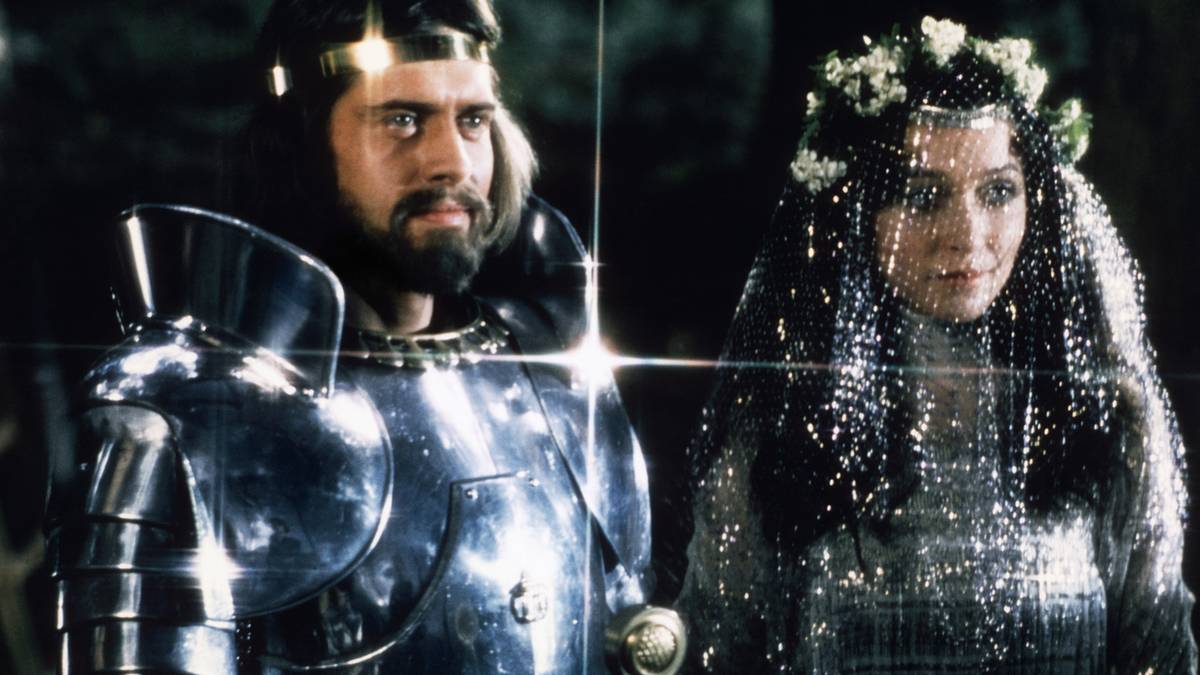
Later, Boorman returned to an earlier idea for a movie about Merlin, and when it was funded, he reused much of the imagery and set design he originally conceived for The Lord of the Rings. “It’s a contiguous world,” Boorman said in the 1981 interview. “It’s like ours but different. I want it to have a primal clarity, a sense that things are happening for the first time. Landscape and nature and human emotions are all fresh.” This clarity of vision gives the movie the unmistakable aesthetic that is, perhaps, its strongest suit. Excalibur’s knights and dames appear to have walked out of a Pre-Raphaelite painting: they are tempting and imposing, erotic and heroic at the same time. They are always framed by greenery and light, the single most important element in the movie.

In a brief essay, art historian Jean-Marc Elsholz examined Excalibur from the viewpoint of the theology of light that, according to him, is perceptible at the heart of the Arthurian cycle. The glimmering green light visible on the knights’ armors and on the surface of the lake from which Excalibur emerges is a reflection of the spiritual light coming from God. But the God of Excalibur is not exactly the Christian God of the Arthurian tradition. Boorman recognized the power of myth to transform and adapt to tell stories suited to different times. In the movie, the Sacred King of Celtic tradition, later commutated into the Arthurian Fisher King, and the Holy Grail all converge into the figure of King Arthur. When Perceval completes the Quest, he discovers the secret of the Grail, and the image of the cup is replaced by that of the King. The religious icon is no longer a representation of the Christianization of society, as it was in the Arthurian legends, and becomes a symbol of political power and authority, which fueled interpretations of the movie as a Thatcher-era conservative apology.
After years of fantasy films and an actual Lord of the Rings movie trilogy, Excalibur is still recognized for heralding an era of sword-and-sorcery flourishing in cinema, even if the movie has little to do with the genre. The deep conceptual roots of the film made it a popular subject for academic study, too. More than anything else, however, Excalibur should be celebrated for the power of its cinematography and composition. There are countless examples, from the scene where Arthur finds Lancelot and Guinevere in the woods and leaves Excalibur between their sleeping bodies to the last ride of the Knights of the Round Table, with spring returning to the kingdom in their wake, accompanied by the epic notes of Carl Orff’s Carmina Burana.
Just like myths carry their meaningful symbolism through the ages thanks to powerful images, so Boorman’s ambitious attempt to adapt King Arthur’s tale lives on through the enduring strength of its visuals.
Excalibur is available to rent on Prime Video and Apple.