Sometimes when I’m trekking through a dangerous game world, I stop to ask: “Who even built this death trap?” I mean, really! Who is the architect behind Dead Cells’ murderous corridors, and why have they dedicated their life to hurting me specifically? With Minos, a morbid new tower defense roguelike, I have an answer to at least part of that question. Why? Because sometimes it’s fun to be a devious little bastard.
Developed by Artificer and published by Devolver Digital, Minos flips an ancient tale of heroism on its back. You are not a brave adventurer looking to slay a vicious monster. You are the vicious monster looking to slay brave adventurers. Specifically, you’re Asterion, the Minotaur of Greek legend who lives in a labyrinth. While the mythology-steeped story that surrounds Minos’ roguelike runs isn’t particularly memorable, Artificer finds fun in twisting ancient tales of Minotaur sacrifices into a darkly inventive video game premise.
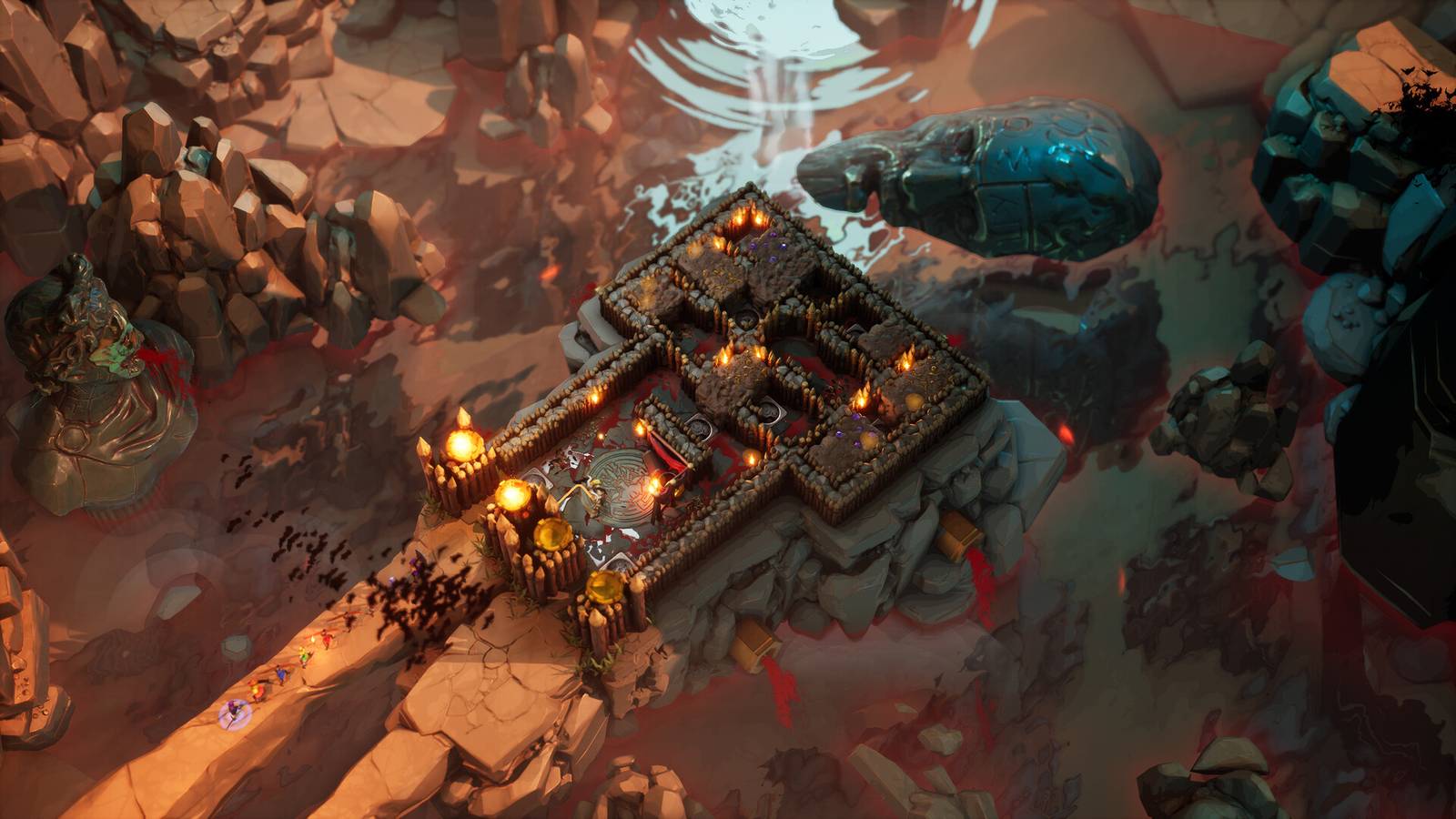
To successfully complete a roguelike run, Asterion must protect different layers of the labyrinth from invading adventurers. Each level tosses him at the center of a small maze layout surrounded by a few doors. A handful of enemies will flood in through those doors over a series of waves, and Asterion needs to kill each of them before they can take him down or seize the center of the room. How can he stop them? By luring them into death traps, of course. That’s basically Minotaur 101!
That’s where Minos finds a gameplay hook that’s both fresh and classical at once. At a very stripped-down level, you’re playing a fairly typical tower defense game. Adventurers will follow the fastest possible route through the maze they can find to reach the center. In a rest phase between waves, players can drop deadly traps down on that path to thin the herd. A hidden set of spikes will stab an unsuspecting archer who walks over it, while a ballista will fire an arrow at whoever enters its line of sight first. Buzzsaws, catapults, sirens that draw the do-gooders off their path and into certain death — there are plenty of ways to brutalize the poor morons. The morbid joy of early-game runs comes from figuring out what each trap does and how they can interact with other traps to create hidden effects.
The clever twist is that you also have control over the maze itself. A building tool allows you to create and erase non-permanent walls to change the route your foes will be forced to take when they flood in. (And before you get too smart, making an impossible path won’t work.) A round is just as much about your mastery of traps as it is making a long maze route that gives you way more opportunities to place said traps. That idea rewards players with sharp spatial reasoning skills, who can send four sets of troops snaking around the screen and hitting every possible trap along the way. When you pull off a successful run, all you have to do is send in the troops and sit back as they are eviscerated one by one before they ever sniff your lair.
The mix of classic tower defense and maze construction is immediately intoxicating. There’s a sick satisfaction to optimizing each wave by adjusting the path and moving traps to new places where they’re sure to get a kill, thus giving Asterion blood that can be used to buy a new trap. Your strategy has to be adaptive, as different enemy types may be immune to specific traps, while others can disable traps altogether. How can you ensure that a meddlesome lemming is the first to die? Minos rewards the reactive tinkerer who is committed to making the perfect death trap.
The idea does eventually hit some walls the more moving parts enter the equation. More involved traps require some fiddly setup, requiring you to link devices to pressure plates that Asterion needs to step on while running around during a wave. Hitting the mark at just the right time can be surprisingly difficult, which makes the usual run of automatic spike pits and fire traps safer. Asterion will also auto-attack enemies if they reach him, but I ran into several instances where he just wouldn’t start swinging at a foe unless I had him in just the right spot. The broad strokes are excellent, but anything that requires tile-perfect accuracy can be a pain.
Game designers can be the world’s biggest pranksters, and you’re the victim of their sick sense of humor.
Minos also struggles with the modern roguelite conundrum of adding gradual meta progression to the mix. Experience points can be used to purchase permanent stat upgrades, additional skills, and more starting gear in each level. At some point, runs can start to feel like resource grinds until you finally unlock enough upgrades to stand a chance at completing a full run. Repetition sets in, though Minos accounts for that a bit by allowing you to unlock shortcuts at a few floor milestones that let you start deeper down on the next run. Occasional twists like treasure-hunting exploration challenges and maze layouts with different rules (revolving floors, decaying traps, that sort of thing) help to keep runs fresh.
Even with some messy edges, I’m finding plenty of devilish satisfaction in Minos so far as I work my way towards victory. I get a shit-eating grin on my face anytime my best-laid plans work out, and I watch a bunch of little troopers reduced to a pool of blood. It’s what I imagine it must feel like being a Dark Souls level designer and finding delight in videos of players walking into all the carefully placed ambushes you worked so hard to hide in plain sight.
I suppose that’s my answer to who makes all these deadly game worlds and why they want me to suffer. Game designers can be the world’s biggest pranksters, and you’re the victim of their sick sense of humor. Minos lets you in on the joke and lets you laugh along with the villains for a change.
Minos is out now on Windows PC. The game was reviewed on Windows PC using a prerelease download code provided by Devolver Digital. You can find additional information about Polygon’s ethics policy here.